


 back to all news
'Contagious Extraction': How a fungus can reshape coffee ecosystems and inspire art
Image

Caption
The Contagious Extraction installation (left) in the FUNGI: Anarchist Designers exhibit at the Nieuwe Instituut in Rotterdam, the Netherlands. The installation, which reinterprets and translates years of research into art, portrays the spread of the destructive coffee rust disease, underscoring that when humans try to intensify an agricultural system to maximize yield, the opposite can happen, and that something as simple as a fungus can stall growth and progress. The installation was a collaboration between SEAS Professor Ivette Perfecto, Zachary Hajian-Forooshani, with whom Perfecto has worked previously, as he earned his PhD from U-M, and the artist Filipp Groubnov. Image credit: Aad Hoogendoorn.
It’s well-established that fungi lurk virtually everywhere—some doing amazing things, and others, such as the Hemileia vastatrix fungus, wreaking havoc. This fungus causes the destructive coffee rust disease, spreading easily through wind, rain and human contact, leaving orange-yellow spots on the leaves of coffee plants. The disease can, and has, led to significant yield losses and even the death of coffee trees across the globe.
University of Michigan School for Environment and Sustainability (SEAS) Professor Ivette Perfecto, whose research has focused on the ecology of coffee agroecosystems in the Americas, was working in Mexico in 2012 when the disease reached outbreak proportions there as well as in Central America and the northern parts of South America.
Perfecto says she and her colleagues have been collecting data ever since, which has led to papers and presentations about the disease and the socio-political aspects. Some years ago, her work caught the attention of anthropologist Anna Tsing, a professor at the University of California, Santa Cruz, who invited Perfecto to present her findings at a conference for anthropologists. Now, Tsing, alongside architect and artist Feifei Zhou, has included her in a new art exhibit, FUNGI: Anarchist Designers.
“Anna had the idea to do something different,” says Perfecto. “Usually, when you start looking at the literature related to fungus and design, there’s a lot about fungus as a model of particular designs or as structured material for construction, but for this exhibit, she wanted to do something that had social and political aspects as well as biological aspects, and not just fungus as builders but as deconstructors.”
For the coffee rust installation, called “Contagious Extraction,” Perfecto collaborated with Zachary Hajian-Forooshani, with whom Perfecto has worked previously, as he earned his PhD from U-M, and the artist Filipp Groubnov. Perfecto explains that, for the organizers, it was central to the exhibit to have artists working alongside scientists to reinterpret and translate research into art.
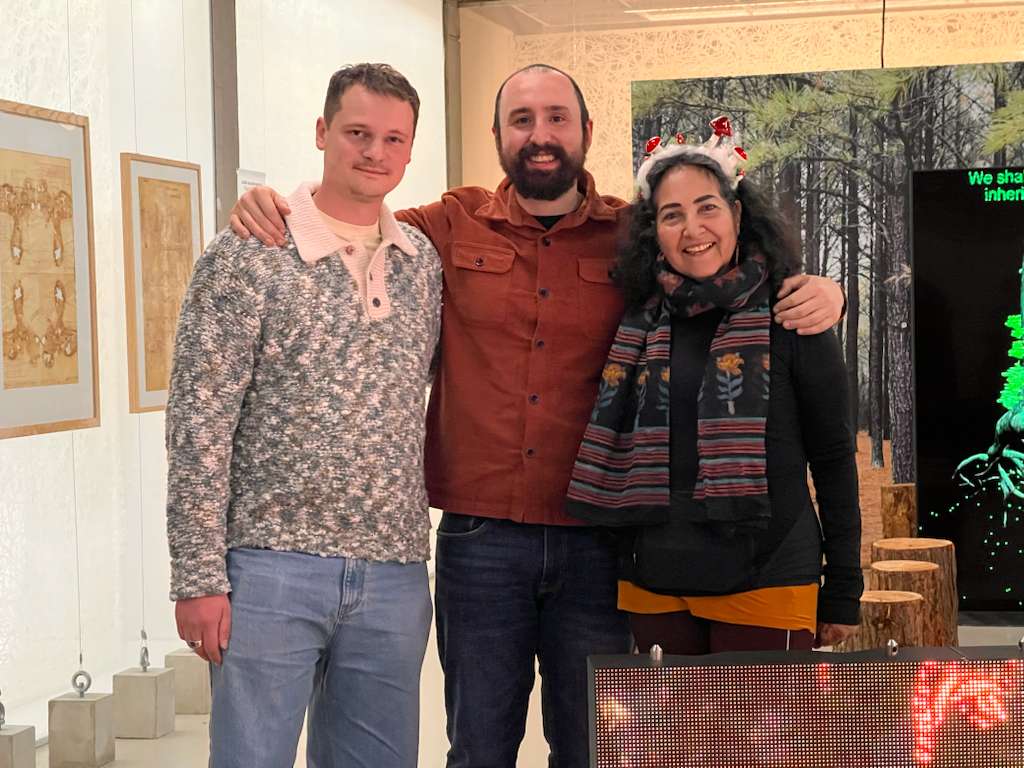
“We started by explaining the whole biology and everything about the coffee rust to him [Groubnov], and then he basically took control,” says Perfecto. “We provided the information to him, and then he proposed what the piece could look like, and we provided feedback. So, it was an iterative process between the artist and the scientists.”
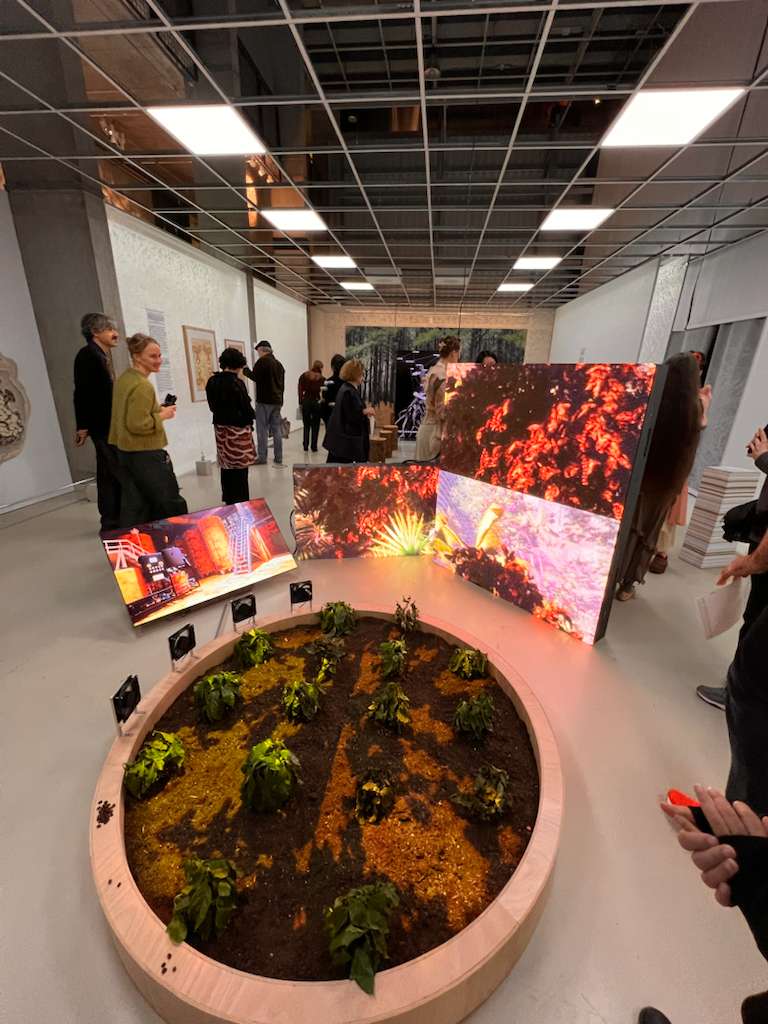 The finished piece portrays the spread of coffee rust, underscoring that when humans try to intensify an agricultural system to maximize yield, the opposite can happen, and that something as simple as a fungus can stall growth and progress.
This isn’t the first time that Perfecto has collaborated with artists to communicate scientific findings, including a musical composition, and it won’t be the last.
“Some years ago, music students from the University of Kansas created a musical composition inspired by our book, Nature's Matrix, co-authored with ecologist John Vandermeer and historian Angus Wright. The book makes the case that a high-quality agricultural matrix, that resembles a natural habitat, promotes the conservation of biodiversity by allowing the movement of forest organisms from fragment to fragment and therefore maintains biodiversity. The musical piece evokes the movement of different kinds of animals across the agroecological matrix.”
FUNGI: Anarchist Designers runs at the Nieuwe Instituut in Rotterdam, the Netherlands, through August 2026.
Read more about Perfecto’s coffee rust research in this article.