


 back to all news
The human cost of recycling tech devices
Image

Caption
E-waste workers use informal and manual methods to extract copper for resale, before it is recirculated back into global supply chains. (photo: Brandon Marc Finn)
From a very young age, we are told to “reduce, reuse, recycle.” We see the three-arrow triangle icon almost everywhere we go, and we hear about sustainability and decarbonization almost daily. We also hear about the dangers of plastic; we know to clip the pop can rings to save fish and to use paper straws to protect turtles.
But what about e-waste recycling? What is it, and how does extracting valuable materials like gold, neodymium, dysprosium and lithium from discarded electronics impact the environment? It’s easily just as important as plastics recycling, but much less discussed. Why?
This disconnect is due in part to our geographical location in the United States, which separates us from what happens to all the different types of waste we produce. We put our recyclable materials into bins or take them to a store and never see them again. When it comes to e-waste, much of the discarded material ends up in the Southern Hemisphere, where millions of tons of e-waste are dumped and left for people to sort through for valuable minerals like copper and aluminum. This leads to two very different outcomes across the Global North and South: a clean, “out-of-sight” reality for consumers in the U.S., and a hazardous livelihood for workers in the Global South, who face chronic exposure to toxins in places like Ghana.
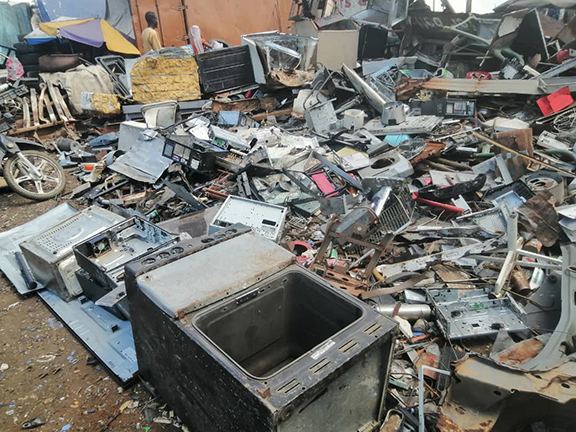
E-waste generation is now rising at five times the rate of documented e-waste recycling. In Michigan, properly recycling old electronics is tough and time-consuming. While Michigan has extended producer responsibility laws that offer free e-waste recycling, electronic devices still end up in the state’s landfills, where they leach hazardous materials into the local environment. Not only is this a massive economic opportunity lost to safely recover critical minerals within the state, but it directly fuels unsustainable practices globally. When e-waste slips through the cracks due to improper regulation and management, or is illegally exported from the U.S., it ends up in places like Agbogbloshie, Ghana, where unprotected informal workers bear the toxic human cost of recovering those materials. Fixing Michigan’s local e-waste infrastructure is the first step in ensuring the green transition does not simply outsource the environmental burdens to vulnerable communities. Michigan is well-positioned to lead this shift because of its robust extended producer responsibility laws, dedicated state funding for innovative recycling technologies, and active grassroots community initiatives.
Of the world’s approximately 62 million tons of global e-waste—defined as “discarded, broken or obsolete devices with cords or batteries, such as phones, laptops and appliances”—only a fraction is managed safely. According to recent scholarship, 82.6%
of all global e-waste is not formally documented, collected, or recycled. This means less than 18% of our discarded tech is handled with proper regulation and occupational safety standards.
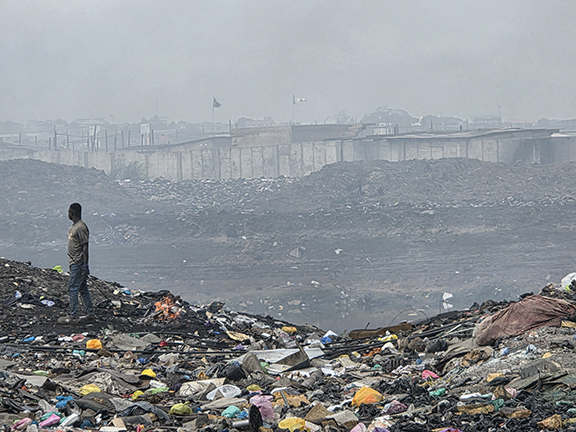
In Ghana, where 15% of global e-waste is deposited, one of the world’s largest e-waste sites can be found in the informal settlement of Agbogbloshie. Informal settlements, which have become more prominent in the Global South, are residential areas where inhabitants lack ownership or rental rights to the land or housing they occupy. A large number, including Agbogbloshie, have emerged around the increasing number of e-waste sites, a troubling consequence of the growing industry.
Brandon Marc Finn, a University of Michigan School for Environment and Sustainability (SEAS) researcher, has visited Agbogbloshie multiple times over the past four years. In 2025, his colleague and fellow SEAS researcher, Dimitrios Gounaridis, joined him. The two met with residents, community leaders and local officials to better understand the complexities of the site and its surrounding community.
Using more than 20 years of data, Finn and Gounaridis are working to make sense of what they call the “informal paradox”; a complex trade-off between relative economic opportunity and exposure to chronic health and environmental harm. This paradox is common at e-waste sites like Agbogbloshie where people engage in ‘informal’ (unregulated and unregistered) economic opportunities while also being exposed to toxicity long-term.
“What we have found is that most of the workers in these informal, unregulated e-waste sites have come there to improve their socioeconomic status or to avoid conflict and famine in their places of origin,” said Finn, who is an assistant research scientist at SEAS. Finn leads work at U-M on urban poverty and mineral flows.
“But, in turn, because of the lack of regulations and standards, these people are being exposed to toxic levels of chemicals and pollution. We found that over 20 years, rates of urbanization and exposure to harmful air pollution have increased dramatically at the same time. People living in the settlement typically do not have ownership or rental rights to the land they live on. Their work goes unprotected and largely unrecognized but is essential to their own short-term survival and the circularity of mineral supply chains.”
In Agbogbloshie, air quality is five times more toxic than what the World Health Organization designates as “safe.” There are approximately 100,000 people living in the immediate surrounding area, and almost the same number of buildings in the area. Yet, more people travel to the site each year in search of consistent work or to avoid conflict in their home states or cities.
“What we are seeing is two phenomena play out simultaneously,” said Gounaridis, an assistant research scientist and geospatial data scientist at SEAS. “These sites are providing critical livelihood for so many people, but at the expense of their own health and the health of the surrounding environment. The circular economy is promoted as a sustainable way to address climate change, but is actually becoming extremely toxic and unsustainable.”
A critical part of why this paradox exists, the researchers note, is the idea of a circular economy. In most respects, circular economies are considered a sustainable production and consumption model for eliminating waste—think the “reduce, reuse, recycle” tagline.
However, in less industrialized countries, such as Ghana, this model can have significant negative ramifications. In these locations, the life cycle of materials like copper, aluminum, lithium and cobalt is closely linked to the informality at multiple points throughout the supply chain. Because capacity and infrastructure are often less stable in these areas, the burden of ensuring the materials are recycled falls onto the workers themselves—through dangerous and toxic methods like open burning and acid-leaching.
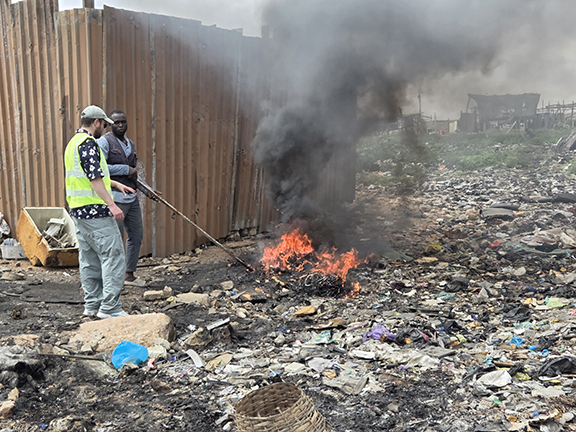
Open burning is an outdoor burning process where air contaminants are emitted directly into the atmosphere without passing through any sort of enclosed chamber (think chimney or smoke stack). This can be a dangerous process and can cause eye and lung irritation and significant fire hazards. Acid-leaching uses a liquid acid solution, commonly sulfuric acid, to dissolve and extract valuable metals. This process produces acidic wastewater and can cause water and soil contamination.
Sites like Agbogbloshie are regarded as “the ‘final’ node of the supply chain for minerals,” according to findings recently published by Finn and Gounaridis.
This study also shows that these “end-of-life” sites are so toxic, in part, because of the lack of regulation at the beginning of—and continuing throughout—the supply chain of metals and minerals. Also according to their findings, the estimated value of these metals in global e-waste stocks in 2019 was $65 billion—and growing.
“This issue of e-waste is not going away, it is growing, and we recognize that,” said Finn. “Informal e-waste workers make this economy circular, so we must respect their work but actively engage with them to improve its shocking long-term human and environmental impacts.
“We are not focused on eliminating it. Rather, we want to understand how the conditions within and around these disposal and recycling sites can be improved while also acknowledging the delicacy of the local contexts in which they reside.”
Throughout their trips to Agbogbloshie, Finn and Gounaridis have been assisting residents in making connections with local community leaders and government officials, providing science-based findings and sharing information to bridge the gap between groups. Linking human and environmental outcomes to supply chain flows is something they learned under the mentorship of SEAS Professor Joshua Newell, with whom both Finn and Gounaridis completed their postdoctoral fellowships at SEAS.
“Listening is such a key part of what we do on these trips,” Gounaridis said. “We are not there to give them information from our own experiences. We are there to listen to theirs, utilize the data, and work together to break down barriers to making these settlements into regulated, healthy and sustainable communities.”
By conducting this research on the ground and meeting with the individuals impacted, Finn and Gounaridis are hoping to call more attention to the issue, starting with the top of the supply chain and moving all the way through.
“A lot of companies pitch their e-waste processes as ‘hey, look at the great things we are doing to be sustainable’, when in reality, the process they are following is extremely harmful,” Finn said. “Our goal is to learn from and share information and build connections with community members at each phase of the process to ultimately reduce the negative impact we are seeing in the ‘end stages’ of supply chains at places like Agbogbloshie.”
Through its strong extended producer responsibility laws and ongoing support for innovative recycling technologies, Michigan can ensure it manages e-waste more responsibly, Finn added. In addition, the state can lead a shift in sustainability thinking
and practice that recognizes the scale and importance of e-waste, including its harmful effects and interconnections with other places like Agbogbloshie, as well as its economic potential to supply the circular mineral economy.
This research received funding from a 2025 Catalyst Grant from the Graham Sustainability Institute at U-M.
Read more in The Conversation.