


 back to all news
From SEAS to sustainability consulting: How one international student launched her career
Image

“In Korea, everything is about the exam. To get a good job, you need good grades, and to get good grades, doing well on exams is highly essential. But when I studied in the U.S., it felt like projects and assignments were considered more important, because it’s proof that you’re really learning something,” said Yunjoo Cho (MS ’25), who recently graduated from the University of Michigan School for Environment and Sustainability (SEAS).
Cho, who specialized in Environmental Policy and Planning and Sustainable Systems, says she chose to study internationally at SEAS because of their curriculum and the diversity of specializations. She said having eight specializations “meant that I will be able to learn all of the different topics in environmental studies. I can learn policy, sciences and GIS. I can learn almost everything. As an early-career professional, I believe it is best to gain as much experience as possible.”
Now an environmental, health and safety and sustainability regulatory consultant at Enhesa, a global provider of regulatory intelligence and compliance solutions that combines experts and AI to service over a third of the Fortune 100 and Nasdaq 100 companies, says her experiences at SEAS, including her internships and coursework, as well as her combined language expertise, contributed to securing her position.
For her capstone experience, one of the core experiences for SEAS master’s students, Cho did a traditional capstone project. Her project, Nature Assessment and Strategy Planning for Steelcase Inc., focused on biodiversity and corporate sustainability for the innovative office furniture and architectural products company. The project team did an initial assessment on the need for nature reporting, including an analysis of Steelcase’s impacts in areas such as water and land use.
Cho also completed two internships during her time at SEAS. Her first was with the United Nations Office for Sustainable Development in Incheon, South Korea. She worked with a variety of Sustainable Development Goals, particularly Goal 12, Responsible Consumption and Production and Goal 13, Climate Action, primarily supporting UN-led workshops and conferences targeted mainly towards government officials from developing countries.
In her last semester at SEAS, Cho secured a second internship with the NASA DEVELOP National Program. Her project, Coastal South Carolina Water Resources Project, focused on mapping isolated freshwater wetlands in coastal South Carolina. She set out to analyze how isolated wetlands have changed over the past decade, from 2015 to 2025, using NASA Earth Observation data and remote sensing techniques. Following her NASA internship, she developed an interest in using machine learning and remote sensing to tackle biodiversity challenges.
On campus, Cho was involved in several organizations. She says one of her favorites was with Michigan Aquaponics, where she helped build an aquaponics system at Matthaei Botanical Gardens designed to raise shrimp and grow vegetables together, improving water and energy efficiency and promoting sustainable aquaculture. Then, in her final semester, as part of an Advanced Life Cycle Assessment class, she evaluated the environmental impact of producing a head of lettuce with the system.
Cho also volunteered as a lab assistant in the University of Michigan Department of Ecology and Evolutionary Biology, where she supported a project collecting invertebrates from samples taken from an artificial coral reef near the Bahamas. She says, “The research was significant as it explores potential alternatives to natural coral reefs, which are rapidly bleaching due to climate change.”
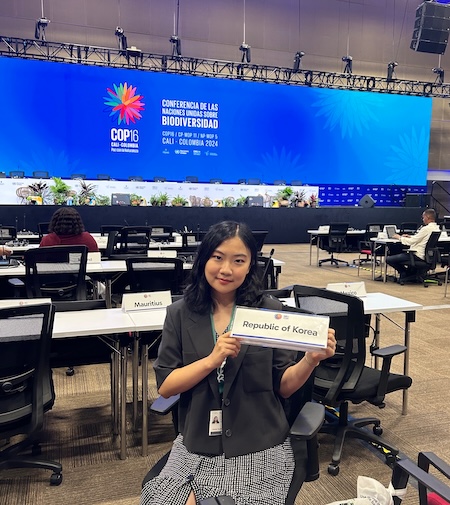 After securing a grant from the Rackham Graduate School, Cho had the opportunity to attend the 16th United Nations Biodiversity Conference in 2024, in Cali, Colombia, as a youth delegate. She says it was a “life-changing moment to me, because it brought together biodiversity experts, academics, businesses, international organizations, and financial institutions from around the world to discuss building a future rich in biodiversity.”
This experience, which she documented in a thorough report, opened Cho’s eyes to how research institutions and academics are applying AI to biodiversity monitoring. This left a strong impression on her and marked a turning point in her career path.
Cho says that being involved with so many opportunities on campus, both for international students and more generally for graduate students, made her feel connected and grounded.
“There are many ways that all students are supported at SEAS. For example, I was matched with other international students to help me get better acquainted with student life, and from the SEAS Student Center and Career Services, I was offered support in understanding how to make a lasting impact during the job interview, which led to success in landing an internship,” says Cho.
Her advice for incoming international students is “whatever you choose to pursue, if it is meaningful and something you truly want to do, plan strategically and never give up. As long as you keep going, you will eventually succeed. Facing and overcoming challenges is a sign of growth, and the SEAS community is there to support you along that growth. I would encourage all students to reach out for support from professors, peers or colleagues, as they are happy to help and may open doors to opportunities you never expected.”