


 back to all news
University of Michigan Symposium on AI emphasized community input and collaboration
Image

Around 300 University of Michigan students, faculty and staff, and community members gathered on October 30, 2025, for the Symposium on AI, Data Centers and the Climate Change Challenge.
The opening remarks were given by Shalanda Baker, U-M’s inaugural vice provost for sustainability and climate action and professor at the School for Environment and Sustainability (SEAS), who emphasized the day’s focus on dialogue.
“Throughout the course of today, we will also engage our students, faculty, researchers and broader community regarding the role the University of Michigan can and must play in grappling authentically with the questions emerging at the nexus of AI usage, data center development, ethics, and sustainability,” said Baker, adding that, as a public university, having such discussions is essential to making progress with climate change, the rapid rise of AI and the related ethical and sustainability challenges.
Baker then introduced the symposium’s keynote speaker, Ruha Benjamin, a sociologist who is the Alexander Stewart 1886 Professor of African American Studies at Princeton University.
In her talk, Benjamin described the importance of power to make decisions affecting communities being shared across those communities rather than top-down and driven by the tech industry, challenging the notion that human nature is selfish.
“There’s just too much evidence to believe the old selfish lie, but if we’re not careful, if we internalize the dominant view of human nature, it becomes a self-fulfilling prophecy,” said Benjamin.
Tying these ideas to narratives about technology, Benjamin said it was important to understand that “not all speed is movement,” and that new systems are not necessarily the right systems.
Benjamin, who, in 2024, was awarded a MacArthur Foundation “Genius” Fellowship, emphasized the importance of considering society and existing inequities in technology decisions and that there is no inevitability to the technologies introduced, discussing some of the ethical risks related to artificial intelligence development and how we’re already seeing some of the consequences, such as facial recognition software resulting in wrongful arrests, among other ethical concerns.
Pondering “who owns the future?” Benjamin suggested that it’s important to question the direction we’re headed, the value of understanding ancestral intelligence as well as the ability to think divergently and with imagination.
Engaging the audience, Benjamin split the room in half, asking one half to respond to her statements with “Be bold,” and the other half with “Get real,” as if a bored teenager were speaking. In response to space travel and AI superintelligence, for example, she pointed to the “Be bold” side, while for free public transportation and canceling student debt, to the “Get real” side. “You get the picture,” she concluded.
Benjamin shared examples of discriminatory design before turning to data centers and the protest movement against them, amidst rising concerns about social and environmental costs. Proposing creativity and community collaboration as an alternative, Benjamin shared the example of “zombie GPUs,” which could offer a more affordable and sustainable alternative to data centers.
“These centers, costing under $10,000 per unit, will process and store data locally, reducing dependence on centralized infrastructure while minimizing environmental impact,” said Benjamin, before turning her attention to the controversial proposed data center in Ypsilanti and the pushback its development has received from surrounding communities.
Concluding her talk with two examples of attempts to improve cities, she described a “smart” project in Toronto, Canada, that claimed it would make things more convenient through surveillance, but that residents ultimately put an end to due to privacy concerns, contrasted with another project, in Barcelona, Spain, which utilizes open-source software and encourages participatory opportunities to create policies that respond to people’s needs, and has seen great success. Benjamin pointed out that the former was tech-driven, while the latter was people-driven.
Returning to the question of “who owns the future,” Benjamin concluded, “The point is not to own or colonize the future; our task is to imagine other forms of relationality that reflect our deep-seated interdependence as people and planet.”
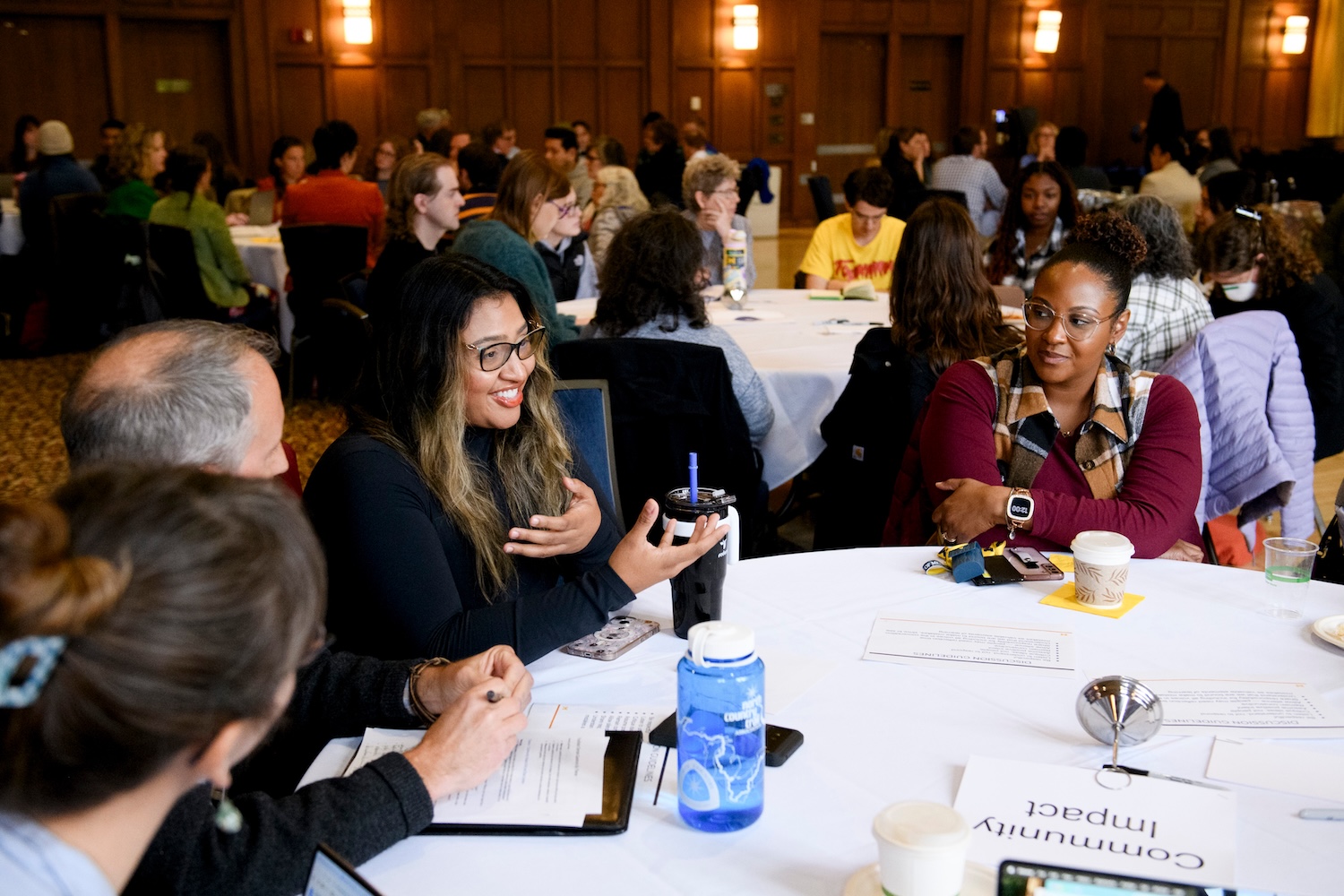 After a brief break, Benjamin sat down with Baker to take questions submitted by audience members before inviting them to roundtable discussions. The discussion topics were:
- Sustainability Implications of AI and Data
- Policy and Governance of Data Centers
- Community Impact
- AI and Academic Experience
The symposium continued into the afternoon with a session focused on research and cross-campus, collaborative efforts to develop a futures-oriented perspective for U-M to take in addressing the challenges raised in the morning session. About 75 faculty and researchers gathered to ideate on themes that U-M should focus on as AI and data centers are booming, and ways to ensure that issues of climate and sustainability are considered and addressed.
The conversation was launched by Baker, who introduced the Michigan Futures Initiative as an opportunity to collaborate and accelerate campus work to develop impactful solutions for society. Framing comments were also provided by Bill Currie, professor and associate dean for research and engagement at SEAS and co-PI and co-director of the Eric and Wendy Schmidt AI in Science Postdoctoral Fellowship Program; and Jing Liu, executive director of the Michigan Institute for Data and AI in Society and also co-director of the Schmidt AI in Science program.
“From the perspective of bringing together people from a wide range of different disciplines across campus, people who had never engaged in conversations about ethical and sustainable AI before, including humanists, policy experts and scientists, this event was a huge success,” said Currie, also noting that “there was a palpable excitement among participants to continue to work together in the coming months to address the critical issues raised by Vice Provost Shalanda Baker.”