


 back to all news
When "stay indoors" isn't enough: wildfire smoke, housing and environmental justice in Detroit
Image

At 7:55 a.m., I woke up suddenly. For a moment I was disoriented. I'm not a morning person, and somehow I managed to wake up before my alarm. Then I realized why.
My bedroom smelled like smoke.
My throat stung. The air inside my apartment carried the unmistakable scent of wildfire smoke, mixed with something that reminded me of burnt spaghetti sauce and cigarettes. The day before, I knew Detroit's air quality had deteriorated because of wildfire smoke drifting south from Ontario. What I didn't expect was to wake up feeling like the smoke had followed me indoors.
I grabbed my phone and opened the weather app. The Air Quality Index (AQI) was approaching 500. My heart sank.
That morning, Metro Detroit briefly recorded some of the worst air quality in the world, with AQI readings climbing to nearly 600. For perspective, an AQI above 300 is considered "hazardous,” which is the highest category in the U.S. Environmental Protection Agency's Air Quality Index.
Wildfire smoke is both a climate and public health issue
Climate change is contributing to longer and more severe wildfire seasons across much of North America. As University of Michigan School for Environment and Sustainability (SEAS) climate scientist Jonathan Overpeck explains, "The current North American wildfire season is surging across the western U.S. and Canada, made worse by the warming and drying effects of human-caused climate change." Even communities hundreds of miles away are increasingly experiencing hazardous smoke events despite being far from the flames.
Wildfire smoke contains fine particulate matter, known as PM2.5, which are particles small enough to travel deep into the lungs and even enter the bloodstream along with other harmful pollutants and gases.
Short-term exposure can irritate the eyes and respiratory tract, trigger coughing and difficulty breathing, worsen asthma and cardiovascular disease and increase emergency room visits. Children, older adults, pregnant people, and individuals with heart or lung disease face particularly high risks.
SEAS wildfire expert Paige Fischer notes that while the destruction caused by wildfires is immediately visible, the health impacts of wildfire smoke receive far less attention. “Beyond the existential crisis that wildfires pose to neighborhoods and communities in the wildland-urban interface, we should be extremely concerned about wildfire impact that is most difficult to control: toxic smoke. We are just beginning to understand how bad wildfire smoke is for human health and how many people are exposed, especially from vulnerable populations.”
That reality is becoming increasingly evident in places like Detroit, where smoke from Canadian wildfires can rapidly degrade local air quality despite the fires occurring hundreds of miles away.
Public health agencies consistently recommend staying indoors during these events. The problem is that this advice assumes your home can actually keep polluted air out.
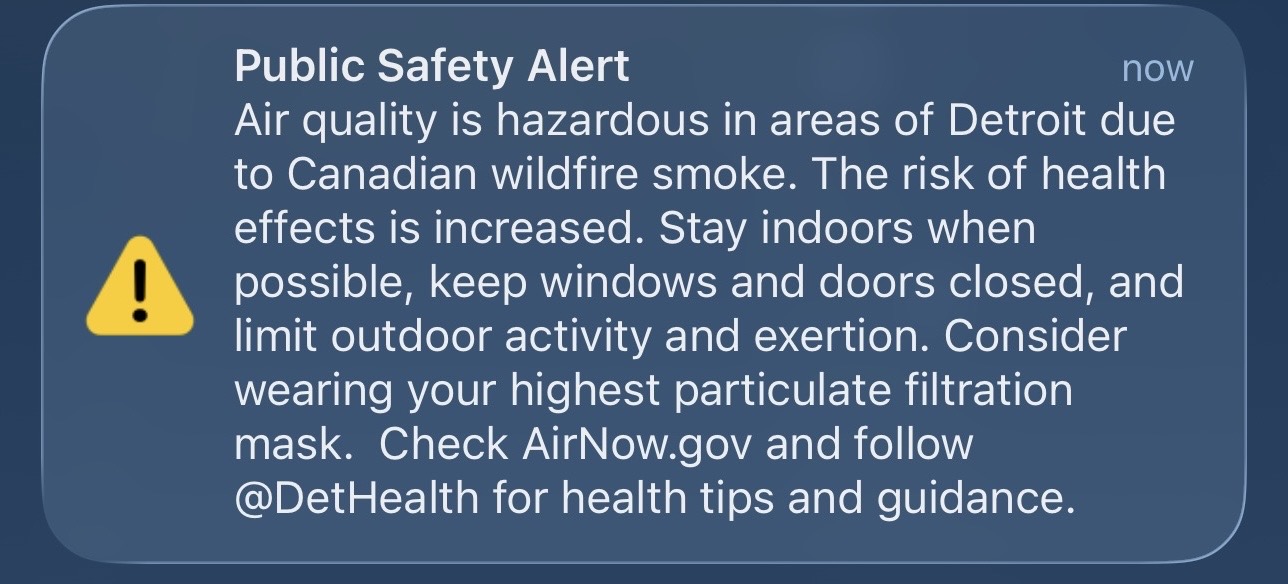
For many Detroiters, home isn't a refuge
Detroit has one of the oldest housing stocks in the country. Roughly 80% of the city's homes were built before the 1960s, meaning many were constructed long before modern energy-efficiency standards and often have aging windows, deteriorating insulation, outdated heating and cooling systems, and other deferred maintenance.
At first glance, these may seem like ordinary maintenance issues. During a wildfire smoke event, they become public health issues. When a home is poorly weatherized, air leaks through gaps around windows, doors, walls, and attics. Those same gaps can allow wildfire smoke and other outdoor pollutants to infiltrate indoor spaces.
For many Detroit residents, the situation is even more complicated during the summer. Wildfire smoke events often coincide with extreme heat, yet many households lack air conditioning. Public health guidance tells people to keep their windows closed, but without a way to cool their homes, that isn't always a realistic or safe option. And while portable HEPA air purifiers can improve indoor air quality, they are out of reach for many households due to their cost.
I experienced this firsthand. Despite staying indoors, my apartment continued to smell like wildfire smoke because outside air was leaking through broken windows. For many Detroit residents living in aging housing, this isn't an isolated experience but a predictable consequence of deteriorating infrastructure.
Housing quality is an environmental justice issue
Poor indoor air quality doesn't affect every community equally.
In Southwest Detroit, predominantly Latino neighborhoods sit alongside heavy industry, including Marathon Petroleum's refinery, major trucking corridors, and other industrial facilities. Residents already experience disproportionate exposure to air pollution. When homes are poorly maintained or inadequately weatherized, those exposures don't stop at the front door.
Nationally, Black Americans are exposed to higher levels of air pollution than white Americans and are more likely to live near major pollution sources. In Detroit's 48217 ZIP code—one of Michigan's most polluted communities—the majority of residents are Black and have spent decades advocating for cleaner air and stronger environmental protections.
Wildfire smoke adds another layer of exposure for communities already burdened by cumulative environmental hazards.
Weatherization can help, but many homes can't qualify
Improvements such as insulation, air sealing, weatherstripping, and proper ventilation can help reduce uncontrolled air leakage while improving comfort, lowering energy costs, and making homes more resilient during extreme weather. During wildfire smoke events, reducing the amount of smoky outdoor air that enters a home can help improve indoor conditions. However, these measures must be paired with appropriate ventilation and other healthy housing practices to ensure indoor pollutants are not trapped inside.
Many of these improvements are already supported through existing weatherization programs. The Weatherization Assistance Program (WAP) primarily serves low-income households by funding energy-efficiency upgrades such as attic and wall insulation, air sealing, and ventilation improvements. The program was created to reduce energy costs for households experiencing energy burden, but as wildfire smoke becomes a more frequent climate hazard, these same improvements also provide an important public health benefit by helping protect indoor air quality.
Yet the households that could benefit most from these improvements are often the least able to access them.
Before weatherization work can begin, homes generally must meet minimum health and safety standards. In Wayne County, many households seeking weatherization first require pre-weatherization repairs because issues such as roof damage, water damage, mold, asbestos, deteriorated windows, or structural deficiencies fall outside the scope of the Weatherization Assistance Program. Without funding to address those underlying repairs, many residents remain in aging homes that continue to leak air, waste energy, and allow outdoor pollutants—including wildfire smoke—to enter.
Renters face an even greater challenge
For renters, the situation is often even more complicated.
During wildfire smoke events, EGLE recommends keeping windows and doors closed and, if available, running central air conditioning on “fan” or “cooling” or a window air conditioner on recirculation, or with the outdoor air vent closed to avoid drawing smoky air indoors.
But many Detroit renters—including myself—don't have central air or even a window unit provided by their landlord.
Detroit's property maintenance code does not require rental units to include air conditioning. If a landlord provides one, it must function properly, but many rental properties have no cooling system at all. Even when tenants recognize problems such as drafty windows, deteriorating seals, or poor insulation, they generally lack the authority to make major improvements themselves.
Enforcement presents another challenge.
Detroit's Buildings, Safety Engineering, and Environmental Department (BSEED) issues thousands of rental blight property violations, yet serious housing problems often persist for months or even years. Apartment complexes across the city have repeatedly faced complaints involving mold, pests, broken heating systems, and inadequate cooling despite receiving code violations.
Knowing this, it's difficult to feel optimistic that the broken windows in my own apartment—which let outside air seep inside—will be repaired anytime soon.
Climate adaptation must include healthier housing
The conditions that produced this smoke event are unlikely to disappear.
Those larger fires don't only threaten the communities where they burn. Their smoke increasingly affects cities hundreds of miles away, making indoor air quality and housing resilience an essential part of climate adaptation.
Emergency responses could include:
- Opening clean-air community spaces equipped with high-efficiency air filtration during hazardous smoke events.
- Creating a HEPA air purifier distribution program to households most at risk.
- Expanding free access to N95 masks and NIOSH-approved respirators during severe smoke episodes.
- Improving public communication so residents know how to reduce indoor smoke exposure.
Long-term investments are equally important.
Detroit has already begun investing in housing repairs through programs such as Detroit Renew, which helps eligible low-income homeowners, older adults, and residents with disabilities address critical home repairs. These efforts are an important start, but they should continue to expand to include comprehensive repairs that prepare homes for weatherization, not just roof or window repairs. Mold remediation, asbestos removal, structural repairs, insulation, and air sealing all help create homes that are healthier, more energy efficient, and better protected from outdoor air pollution.
As wildfire smoke becomes a recurring climate hazard, policymakers should begin thinking about healthy housing differently. Historically, weatherization programs have been viewed primarily as energy-efficiency initiatives because they lower utility bills and reduce energy burden. Those benefits remain essential, but investments in weatherization, home repair, ventilation, mold remediation, and other housing improvements should also be recognized as investments in public health and climate resilience.
Rather than treating energy affordability, housing quality, and public health as separate issues, cities have an opportunity to address them together through more accessible weatherization and home repair programs.
Safe housing is climate resilience
When public health officials tell us to "stay indoors," they're giving sound advice.
But that advice assumes everyone has a home capable of keeping hazardous air outside. For thousands of Detroit residents living in aging, undermaintained housing, that's simply not the case.
Climate resilience isn't just about preparing for the next wildfire season. It's also about ensuring people have healthy homes that can protect them during climate-related hazards. That means investing not only in emergency response, but also in housing quality through home repair.
Because when the next smoke event comes—and it will—the safest place to be should actually be indoors.