


 back to all news
Not afraid of snakes or new experiences: Ivy McDonald is making the most of her time as a PitE student
Image

Caption
Ivy McDonald (BS '27), working in one of the microclimate plots in Naxos, Greece, where her research team was collecting climate data in Summer 2025.
“I’ve always cared about the environment, and I always like to say that I don’t want to follow in my parents' footsteps, but they both worked for the state's environmental quality office. As much as I don’t want to do what they do, I do want to do what they do,” says Ivy McDonald (BS '27), a junior in the University of Michigan Program in the Environment (PitE).
McDonald came to U-M thinking she wanted to do environmental engineering, but after taking some courses, she began to realize what she really wanted was in PitE and Ecology and Evolutionary Biology (EEB). She says one of the reasons she chose PitE, a jointly managed program between the School for Environment and Sustainability (SEAS) and the College of Literature, Science, and the Arts, was that she liked the idea of having a smaller community and more guidance from advisors and professors, and she has found just that. “I like that here, in the Dana Building, I’m recognizing people, and that’s just crazy on this big of a campus.”
Currently leaning toward specializing in biodiversity, McDonald says her favorite course so far has been Geology of National Parks and Monuments with Rebecca Lange. She described how this class taught her about how much there is to learn in the field of geology. McDonald also enjoyed Ecology and Religion with Rolf Bouma. “I didn’t think it was going to be much of a combination, but it was. It kind of helps me connect everything about life, social justice and environmental issues,” she says.
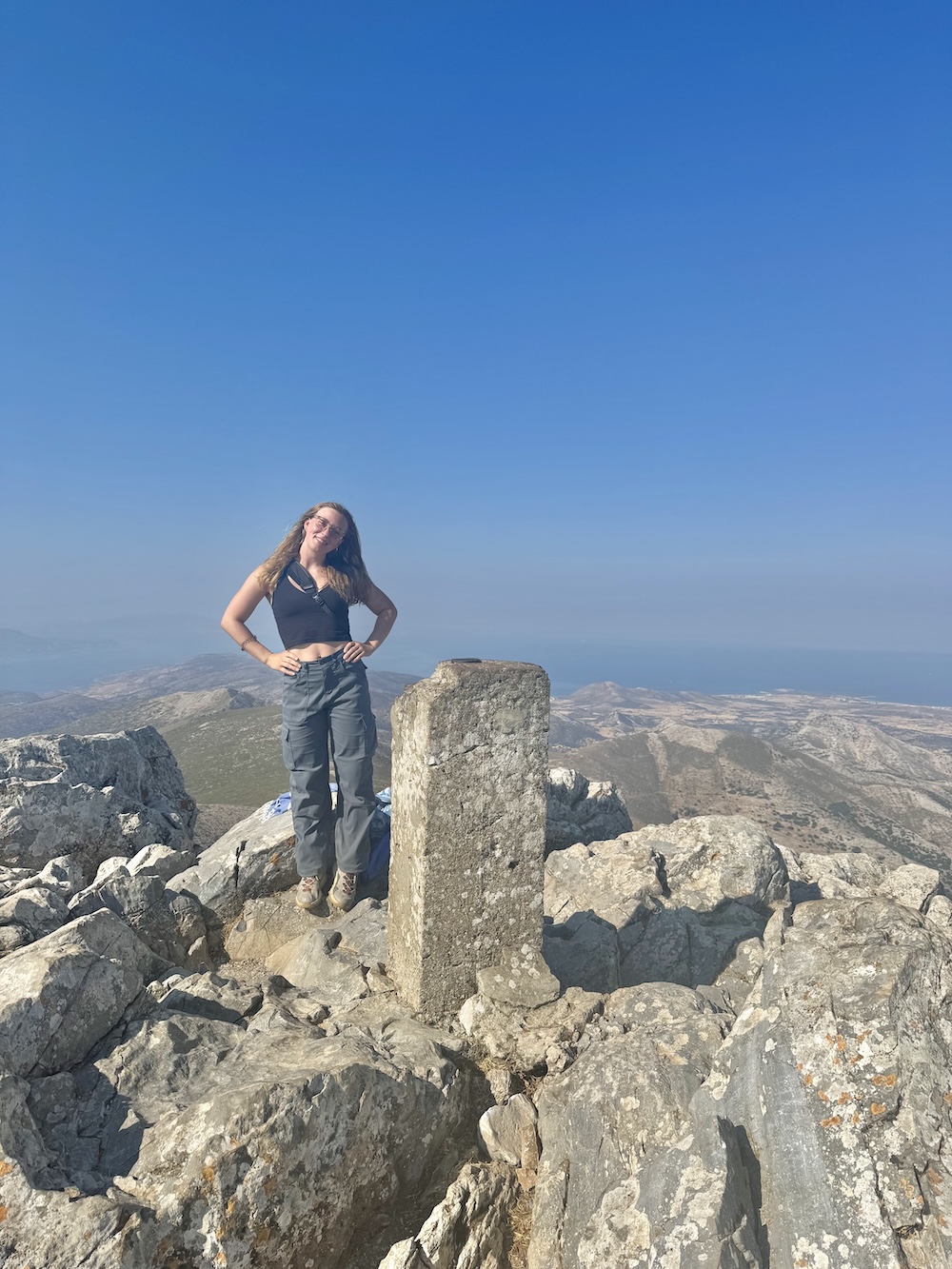
This past summer, McDonald was a summer research assistant working with SEAS PhD student Collin Richter. She applied for the position because she wanted to get a deeper understanding of what conducting research entails. Richter notified McDonald that she was selected, with one important question: “Are you scared of snakes?”
Turns out she wasn’t. McDonald spent five weeks in Naxos, Greece, with Richter, where they collected microclimate data. McDonald explained that the main task of the research was to take 100 sets of measurements, morning and night, of designated plots of land, which allowed them to fill in research gaps of climate data on a scale applicable to small organisms. Currently, climate research on topics such as temperature and ground cover is typically conducted on a larger, kilometer-based scale.
“Since herpetofauna [reptiles and amphibians] don't travel kilometers and kilometers each day to find sun, this is relatively unhelpful when studying how climate changes will affect their distribution,” McDonald says.
Working alongside them was another set of researchers from San Diego State University who were working under a previous student of Johannes Foufopoulos, Richter’s PhD advisor, collecting the snakes that McDonald and Richter would use for their data collections.
“We set up an arena where we were staying, a hot side and a cold side, left the snakes in there for 5-6 hours, and let them choose their preferred temperature,” McDonald explains. “We have their environmental, preferred and maximum temperatures, because that’s what we care about in reference to climate change.”
She also had the opportunity to travel to Athens, Greece, with Richter to attend a four-day ecology and zoogeography conference. She says she enjoyed listening to and observing many of the presenters at the conference.
For PitE students, McDonald highly recommends getting involved in research opportunities and shares that she thinks it’s important to learn how research is conducted in the field, while also learning about other cultures.
“Say yes to any experience that you can. There are so many opportunities within PitE, and I think that’s the best thing that comes from being in the program, all of the experiences.”