
  • Admissions
  • Exploring Grad School
  • Current Students
  • Community Impact and Engagement
  • Faculty + Staff
  • Alumni
Give
Intranet
Request Info
Home
  • Academics
    • Master of Science
    • Master of Landscape Architecture
    • Doctoral (PhD)
    • Dual-Degree Programs
    • Graduate Certificate Programs
    • Undergraduate Program
    • Courses
    • Online Learning
  • Research + Impact
    • Sustainability Themes
    • PhD Profiles
    • Student Research
    • The Centers, Institutes + Initiatives
    • Faculty Profiles
    • Labs
  • Prospective Students
    • Why Michigan?
    • Application Information
    • International Students
    • Financial Aid + Tuition
    • Visit Campus
    • Faculty Profiles
    • Admitted Students
    • Application Success Webinars
  • Student Services
    • SEAS and PitE Student Center
    • Career Services
    • Financial Aid
    • Academic Advising
    • Student Organizations
    • Student Development
    • Forms, Handbooks + Policies
    • Quick Links
  • News
    • Community Highlights
    • In the Media
    • Stewards Magazine
  • Events
    • Co-Sponsorship Form
    • Submit Event
    • Admissions Webinars
    • Gallery
  • About
    • Who We Are
    • SEAS Values
    • Collective Impact Committee
    • Leadership
    • Demographics
    • Faculty Profiles
    • Administrative Departments + Staff
    • Facilities + Locations
    • Community Impact and Engagement
    • Art & Environment Gallery
    • COVID-19
    • Land Acknowledgement
    • History
    • Email Sign-Up
Search search icon
  • Admissions
  • Exploring Grad School
  • Current Students
  • Community Impact and Engagement
  • Faculty + Staff
  • Alumni
Give
Request Info
search icon Search
Institute for Global Change Biology
  • Overview
  • Who We Are
  • What We Do
  • Training Opportunities
  • Research
  • Engage With Us
  • Exchange Program
  • Faculty Hiring
  • Graduate Students
  • Postdoc Opportunities
  • Call for Working Group Proposals
  • News & Events
  • Publications
  • Overview
  • Who We Are
  • What We Do
  • Training Opportunities
  • Research
  • Engage With Us
  • Exchange Program
  • Faculty Hiring
  • Graduate Students
  • Postdoc Opportunities
  • Call for Working Group Proposals
  • News & Events
  • Publications

Quantifying the benefit and feasibility of greening as a strategy for carbon sequestration, extreme event adaptation, and disease reduction

Greening and afforestation of metropolitan areas (MAs) is an effective nature-based solution (NbS) for mitigating climate change through increasing the terrestrial carbon sink. Our proposed project recognizes and addresses the critical need for careful design of greening solutions that consider the evolving climate dynamics of extreme events and the potential impacts of greening on public health.
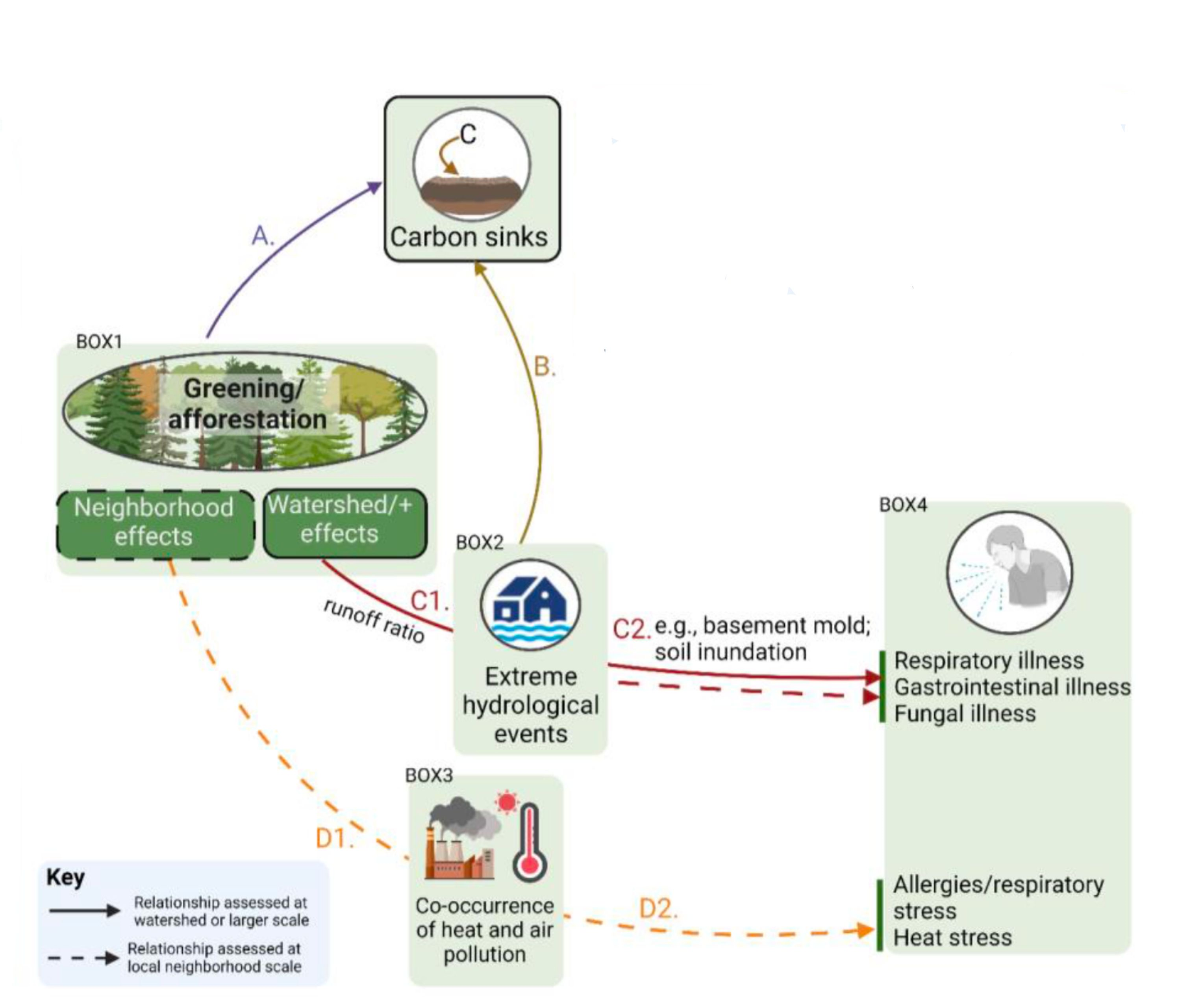

Figure 1. Conceptual framework depicting the interactions between urban greening, climate change mitigation, adaptation, and disease buffering. The links (a, b, c, and d) in the causal diagram represent the key research questions in this proposed project that pertain to quantifying the fundamental relationships between greening, carbon sequestration, and other co-benefits for flooding, heat, air pollution, and health.


Researchers Involved:

 Qiaoqiao Li
Qiaoqiao Li
Postdoctoral Researcher, Department of Climate and Space Sciences and Engineering
[email protected]

More info

Profile for Mohammed Ombadi
Mohammed Ombadi
Assistant Professor, Department of Climate and Space Sciences and Engineering
[email protected]

More info

seas logo
University of Michigan
School for Environment and Sustainability
Dana Building
440 Church Street
Ann Arbor, MI 48109
(734) 764-6453
Email us
follow us on facebook
follow us on twitter
follow us on instagram
follow us on linkedin
follow us on youtube
follow us on flickr
planet blue global impact logo
  • Contact us
  • Intranet
  • Contact Web Team
  • Email Sign-Up
  • Report Sexual Misconduct

© 2026 The Regents of the University of Michigan | Privacy Policy

Produced by Michigan Creative