


 back to all news
Professors of Practice Shriberg and White bring practical experience into the classroom
Image
Caption
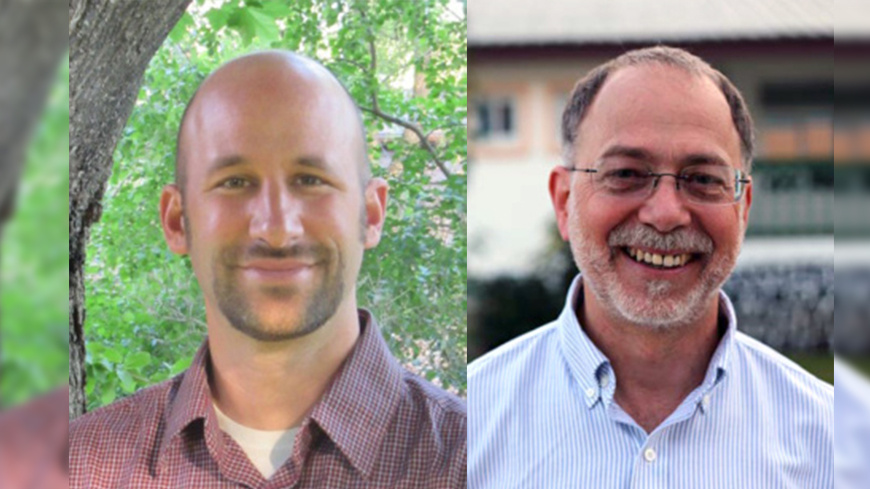
SEAS Professors of Practice Mike Shriberg (left) and Andy White.
As professors of practice and engagement at the University of Michigan School for Environment and Sustainability (SEAS), Mike Shriberg (MS ’00, PhD ’02) and Andy White bring to the school extensive practical experience leading organizations and supporting communities to advance their justice, sustainability and environmental goals.
Both professors, who joined SEAS nearly a year ago, are building on the work of former SEAS Professor of Practice Paul Seelbach, who retired last summer. In their roles, Shriberg and White teach courses, advise master’s projects, and build professional connections that help SEAS master’s students develop the practical and professional skills needed to be successful in the workplace and become future leaders.
Shriberg and White focus on teaching competencies related to leadership, social change, project management, navigating difficult situations and people, communication and listening, working with the media, and advocating for equity and justice, among others. These skills complement the scientific and research knowledge students gain from theoretical courses, Shriberg noted.
“SEAS is well known for its ability to motivate action and have an impact on moving society toward sustainability,” said Shriberg. “I’m excited to draw upon my experience and help co-develop changemaker skills with the next generation of SEAS leaders, and to work with other SEAS faculty on maximizing our collective impact today.”
“I’m excited about SEAS’ strengthened commitment to practical impact and the opportunity to help these amazing students see how they can change the world,” added White. “I’m also thrilled to be getting to know the extensive work underway by the incredible SEAS research faculty. I see the possibilities for much greater impact by connecting and leveraging both the research and the practical capacities.”
As part of their roles, Shriberg and White also teach theme-based master’s project courses. Taught as a structured series over three semesters, each course consists of four master’s student teams working collaboratively on projects with a related thematic focus, such as Great Lakes water, climate, and communities and conservation and restoration.
Shriberg’s expertise is in Great Lakes water issues, local and state energy policy, campus sustainability, and environmental leadership. He teaches Great Lakes water policy, climate/energy policy, and environmental advocacy strategy. Prior to SEAS, he was the Great Lakes regional executive director at the National Wildlife Federation and was a lecturer at U-M for more than 20 years (including serving as the Graham Institute’s education director). As part of his professorship, Shriberg is the director of engagement for the Cooperative Institute for Great Lakes Research and Michigan Sea Grant. More about Shriberg’s work can be found here.
Shriberg is working on several master’s projects, including one focused on helping Great Lakes states meet their 30 x 30 conservation goals in the open water, working to empower local decision makers on Great Lakes coastal resilience, and mitigating harmful algal blooms and their impacts in Lake Erie. Another project revolves around helping client organization Great Lakes Now implement a media model that will serve as an example for building and developing strong local and regional media programs to increase public awareness of environmental justice issues.
White teaches a theme-based master’s project course on Indigenous and community-led conservation and climate action. His global expertise focuses on land rights, forest policy, and the role of Indigenous Peoples and local communities in climate change. Prior to SEAS, he was the Coordinator of the Rights and Resources Initiative (RRI), and co-founder and president of its secretariat, the Rights and Resources Group. White continues to serve on the board of RRI, as well as an advisor to the First Nations Development Institute, the Department of Natural Resources of the Eastern Band of the Cherokee Indians, and the Center for Native Health. You can read more about White’s work here.
A major initiative that White is convening, in collaboration with SEAS Professors Kyle Whyte and Arun Agrawal, is the new Pathways Alliance for Change and Transformation (PACT). PACT is a small, strategic coalition of Indigenous Peoples and local community-led research and activist institutions and academic allies. “PACT’s vision is to catalyze the transformation of systems at all levels to support the priorities and values of Indigenous Peoples and local communities and their organizations,” White said. The core strategy to achieve PACT’s vision is to strengthen the self-determination of emerging Indigenous and community scholar-activists, strengthen Indigenous and community-led research, and deepen the relationships between them within and across regions.