

  • Exploring Grad School
  • Current Students
  • Faculty + Staff
  • Alumni
Give
Intranet
Request Info
Home
  • Academics
    • Master of Science
    • Master of Landscape Architecture
    • Doctoral (PhD)
    • Dual-Degree Programs
    • Graduate Certificate Programs
    • Undergraduate Program
    • Courses
    • Online Learning
  • Admissions
    • Why SEAS?
    • Master’s Admissions
    • Doctoral Admissions
    • Online Certificate Admissions
    • Tuition and Funding
    • International Students
    • Connect with Us
    • Fall Webinar Series
    • Admitted Students
  • Research + Impact
    • Sustainability Themes
    • PhD Profiles
    • Student Research
    • The Centers, Institutes + Initiatives
    • Faculty Profiles
    • Labs
  • Student Services
    • SEAS and PitE Student Center
    • Career Services
    • Financial Aid
    • Academic Advising
    • Student Organizations
    • Student Development
    • Forms, Handbooks + Policies
    • Quick Links
  • News
    • Community Highlights
    • In the Media
    • Stewards Magazine
  • Events
    • Co-Sponsorship Form
    • Submit Event
    • Admissions Webinars
    • Gallery
  • About
    • Who We Are
    • SEAS Values
    • Leadership
    • Office of Community Impact and Engagement
    • Demographics
    • Faculty Profiles
    • Administrative Departments + Staff
    • Facilities + Locations
    • Art & Environment Gallery
    • Land Acknowledgement
    • History
    • Newsletter Sign-Up
Search search icon
  • Exploring Grad School
  • Current Students
  • Faculty + Staff
  • Alumni
Give
Request Info
search icon Search

PhD Profiles

seas neon sign
  • Academics
    • Master of Science
    • Master of Landscape Architecture
    • Doctoral (PhD)
      • PhD Profiles
    • Dual-Degree Programs
    • Graduate Certificate Programs
    • Undergraduate Program
    • Courses
    • Online Learning
  • Admissions
  • Research + Impact
  • Student Services
  • News
  • Events
  • About
  • Academics
    • Master of Science
    • Master of Landscape Architecture
    • Doctoral (PhD)
      • PhD Profiles
    • Dual-Degree Programs
    • Graduate Certificate Programs
    • Undergraduate Program
    • Courses
    • Online Learning
  • Admissions
  • Research + Impact
  • Student Services
  • News
  • Events
  • About
  1. Home
  2. ›
  3. Research + Impact
  4. ›
  5. PhD Profiles
  6. ›
  7. Amy Zuckerwise
back to all PhD profiles

Amy Zuckerwise
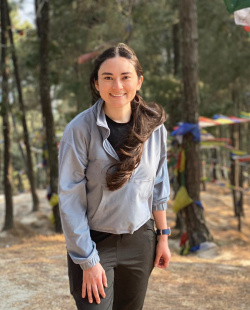
Amy Zuckerwise
[email protected]
Entering Year
2021
CV file

Amelia ("Amy") is an interdisciplinary wildlife scientist interested in the dynamics of felids in shared landscapes. For her dissertation, she investigates the behavioral and adaptive responses of tigers and people as this endangered species undergoes recovery in the Terai Arc Landscape of Nepal. She integrates cross-scale methods from both ecology and social science, from geospatial modeling and satellite tracking to individual household surveys. Through disentangling the complexities of human-wildlife relationships, her research aims to promote effective and equitable conservation innovations that contribute to resilient coexistence. Previously, she has researched indigenous and local knowledge of ocelots in the Bolivian Amazon, tracked bobcats and pumas across California, and participated in global conservation policy planning.

Education

Master of Environmental Science, Yale University School of the Environment, 2020

Bachelor of Science in Biology, Stanford University, 2015

Advisor
Neil Carter
Advisor Specialization(s)
Geospatial Data Science
Research

Carter, N.H., Berti, E., Zuckerwise, A., & Pradhan, N.M.B. (2024). Energetics-based connectivity mapping reveals new conservation opportunities for the endangered tiger in Nepal. Animal Conservation, 27(5), 639-647. Energetics-based connectivity mapping reveals new conservation opportunities for the endangered tiger in Nepal

Carter, N.H., Zuckerwise, A., Pradhan, N.M.B., Subedi, N., Lamichhane, B.R., Hengaju, K.D., Acharya, H.B., & Kandel, R.C. (2023). Rapid behavioral responses of endangered tigers to major roads during COVID-19 lockdown. Global Ecology and Conservation, 42, e02388. Rapid behavioral responses of endangered tigers to major roads during COVID-19 lockdown

Related Links
Conservation & Coexistence Group
Society for Conservation Biology UM Chapter
Nepalese tigers showed rapid behavioral response to reduced road traffic during COVID-19 lockdown, study finds
PhD student Amy Zuckerwise awarded NASA fellowship
Fostering human-tiger coexistence in Nepal
seas logo
University of Michigan
School for Environment and Sustainability
Dana Building
440 Church Street
Ann Arbor, MI 48109
(734) 764-6453
Email us
follow us on facebook
follow us on twitter
follow us on instagram
follow us on linkedin
follow us on youtube
follow us on flickr
planet blue global impact logo
  • Contact Us
  • Intranet
  • Contact Web Team
  • Newsletter Sign-Up
  • Report Sexual Misconduct
  • Request Program Information

© 2026 The Regents of the University of Michigan | Privacy Policy

Produced by Michigan Creative