


PhD application deadline for Fall 2027
December 1, 2026
All applications must be submitted by 11:59 p.m. Eastern Time.
A more accessible application process
- There is no fee to apply for domestic applicants.
- We are no longer requiring or accepting GRE scores.
SEAS applications are submitted through Rackham Graduate School, U-M's central graduate admissions office.
Your First Step
Before you apply, we encourage you to explore SEAS faculty and connect with those whose research aligns with your interests. These conversations can help you learn more about potential research opportunities, identify areas of shared interest, and determine whether SEAS is the right fit for your doctoral goals.
Explore faculty research profiles and contact information here.
Learn more
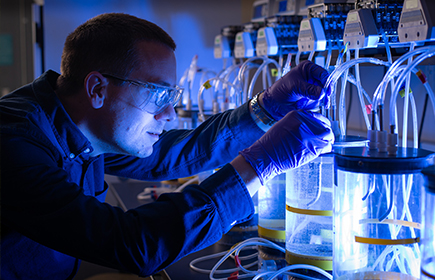
Join our virtual and in-person events and stay connected!
PhD Program Funding
University of Michigan Ph.D. students have one of the strongest compensation packages in the United States. Students admitted to the SEAS PhD program receive a five-year funding package, provided they remain enrolled full time and make satisfactory progress toward the degree.
The package includes:
- Tuition support for five academic years, covering four pre-candidate semesters and six candidate semesters.
- GradCare health insurance for five academic years and four summers.
- A monthly stipend benchmarked to a 50% Graduate Student Instructor (GSI) appointment. For 2026–2027, the stipend is approximately $3,649 per month.
Funding may come from a combination of fellowships, GSI appointments, Graduate Student Research Assistant (GSRA) appointments, and external funding. As a result, the source of your funding may change during the program even though the overall funding commitment remains in place.
Your Application Checklist
1. Start Your Application
The links below will take you to the Rackham Graduate School website. Rackham serves as the administrative home for graduate programs at the University of Michigan.
2. Choose Your Program
Scroll down to "Environment & Sustainability" in the Rackham Application Portal
- PhD applicants choose: Environment and Sustainability PhD
3. Provide Your Transcripts
- All applicants must upload a scanned copy, front and back, of their official transcript/academic record issued by the Registrar or Records Office, to ApplyWeb for each bachelor’s, master’s, professional, or doctoral degree earned or in progress. The scanned copy of the official transcript is used for initial review by the graduate program faculty.
- If you have community or junior college, non-degree, or study-abroad coursework, indicate this information on page nine of the application under the “Additional Education Information” section. Do not submit any transcripts from a community or junior college, non-degree, or study abroad coursework to Rackham unless you attended a non-U.S. institution
-
International applicants can convert their grades to a U.S. GPA using the Scholaro GPA Calculator if your institution provides the cumulative average grade (e.g., 88/100, 8.5/10, or 4.6/5.0) on your academic record/transcript. If your institution does not provide the average or you attended more than one institution, calculate your average using the following formula for each institution you attended:
- Add all the numerical results for courses taken during your undergraduate study.
- Divide the sum total number by the number of courses taken. This is your average result.
- Take this average and convert using the Scholaro GPA Calculator.
Important note on encrypted transcript files:
Please ensure that any documents you upload, such as transcripts, are not encrypted or contain macros, as this can cause errors in the application system. Transcripts provided through electronic services like eScrip-Safe, Parchment, and the National Student Clearinghouse are typically encrypted. To resolve this, you should print the electronic transcript, then scan and upload the printed copy to your application.
4. Provide Your Test Scores
- SEAS no longer requires the submission of a GRE for all master's and PhD programs.
- Applicants whose native language is not English must demonstrate English proficiency via TOEFL or IELTS scores, unless they meet the Rackham Graduate School criteria for an exemption.
- Additional information regarding test scores is available on Rackham’s website.
The links above will take you to the Rackham Graduate School website. Rackham serves as the administrative home for graduate programs at the University of Michigan.
5. Update Your Resume
- Make sure your resume provides current educational information and professional experience, including dates. These dates should match your application.
- Including community service activities and your hobbies/interests is encouraged, as it helps us get to know you better.
- Your resume should be no longer than two pages.
6. Write Your Essays and Share Your Work
Academic Statement of Purpose
The academic statement of purpose is your chance to introduce yourself to the faculty and articulate how pursuing graduate study at the School for Environment and Sustainability (SEAS) aligns with your long-term goals. Faculty members use this statement to gauge your education and career objectives and assess your ability to write and organize your thoughts effectively.
Your statement should be approximately 1000 words or between three to five double-spaced pages. Detail your academic and research background, your career and educational objectives, and how the SEAS PhD program will support your ambitions. Indicate your planned research project and the faculty member(s) you have consulted.
Personal Statement
Approximately 500 words in length, your personal statement should reflect how your background and life experiences—including cultural, geographical, financial, and educational factors—have shaped your decision to pursue a graduate degree at the University of Michigan. Highlight your personal journey that has led you to apply to SEAS, ensuring not to duplicate content from your academic statement of purpose.
Writing Sample
Your application will include a writing sample of around 30 pages (not including citations) of which you are the primary author. Writing samples do not need to be precisely 30 pages in length, but they should not be significantly longer or shorter.
The sample may come from a variety of sources, such as a course essay or paper, a research or lab paper, a thesis or thesis chapter, or another substantial piece of academic or professional writing. Use your best judgment in selecting a sample that best represents your individual writing abilities and demonstrates your ability to communicate ideas clearly and effectively.
Note on the Use of Generative AI
Applicants are advised to familiarize themselves with Rackham Graduate School's policies on the use of generative AI in application materials. For guidance and detailed policies, please see Rackham's guidance on the use of GenAI.
7. Choose and Register Your Recommenders
- PhD applications require three letters of recommendation.
- Applicants will register their letter writers via the online application system, which will generate an emailed set of instructions (sent to each letter writer) to upload their letter electronically.
- Recommendation letters are one of the best ways for the faculty and staff who review your materials to learn about your strengths and understand how you stand out. Choose recommenders who work in your area of interest and can vouch for your capacity to work on team projects and/or conduct research. Make sure your recommenders feel capable of writing a strong letter for you and give them plenty of time to complete the task (four weeks, if possible).