


 back to all news
Beyond solar energy: SEAS students reimagine multifunctional landscapes
Image

Caption
The 2026 ASLA Student Honor Award Ceremony, Los Angeles, Sept. 16, 2026. SEAS students and faculty advisor Yekang Ko celebrate the national recognition of their interdisciplinary landscape design project.
An interdisciplinary studio tackles real-world challenges in renewable energy planning, earning national and state ASLA awards
How can communities expand renewable energy while protecting farmland, supporting biodiversity and creating local benefits? Five University of Michigan School for Environment and Sustainability (SEAS) students explored this challenge through an interdisciplinary landscape planning and design project that has received national and state recognition.
Their project, Harper Preserve: Agrivoltaic Research Park + Community Center, received a 2026 American Society of Landscape Architects (ASLA) Student Honor Award in Student Collaboration, along with two Michigan ASLA (MiASLA) awards: the Student General Design Honor Award and the Award of Excellence for Social Equity, the Michigan chapter’s highest distinction.
Developed in EAS 687: Landscape Planning Analysis, the project used U-M’s Harper Preserve as a case study to envision how solar energy production could coexist with agriculture, ecological conservation, research and community uses.
The team included Landscape Architecture students Kayla Vaccaro, Kate Perazzo, Yunjia Zou and Zhiyu Guo, and Environmental Planning and Policy student Daniela Cruciani. Their faculty advisor was Yekang Ko, associate professor of landscape architecture at SEAS and instructor of EAS 687.
“Receiving a National ASLA Student Honor Award is an extraordinary achievement,” said Ko. “It is one of the highest recognitions for landscape architecture students, selected from a highly competitive international pool. I am incredibly proud of this team—not only for the quality of their design work, but for the thoughtfulness and rigor they brought to such a complex challenge.”
“Receiving an ASLA Honor Award for our design project meant the world to our group,” said Perazzo. “This recognition reinforced the value of the interdisciplinary, place-based approach we took to the project.”
Rethinking renewable energy landscapes
EAS 687 integrates landscape planning theory, geographic information systems-based spatial analysis and design thinking. Students examine ecological, social and land-use systems and apply their findings to real-world environmental challenges.
“The energy transition is also a landscape transition,” Ko explained. “Renewable energy infrastructure affects land, ecosystems, communities and peoples relationships with place. This studio asked students to think beyond energy production and explore how solar landscapes could also support agriculture, habitat, research and community needs.”
This approach reflects Ko’s recent research on integrated landscape approaches to renewable energy planning and energy infrastructure as multifunctional landscapes.
Harper Preserve is a 375-acre U-M-owned property encompassing agricultural fields, wetlands, forests and Murray Lake. Working with this site and engaging with stakeholders and experts from science, engineering, planning and policy allowed students to explore the complex relationships between renewable energy development, agricultural land preservation, biodiversity and rural communities.
Through spatial analysis, research and design, the team developed a conceptual vision for a multifunctional agrivoltaic landscape that could support renewable energy production alongside farming, habitat conservation, research and community benefits. While grounded in real-world challenges, the project was an academic planning and design exercise, not an approved or proposed U-M development project.
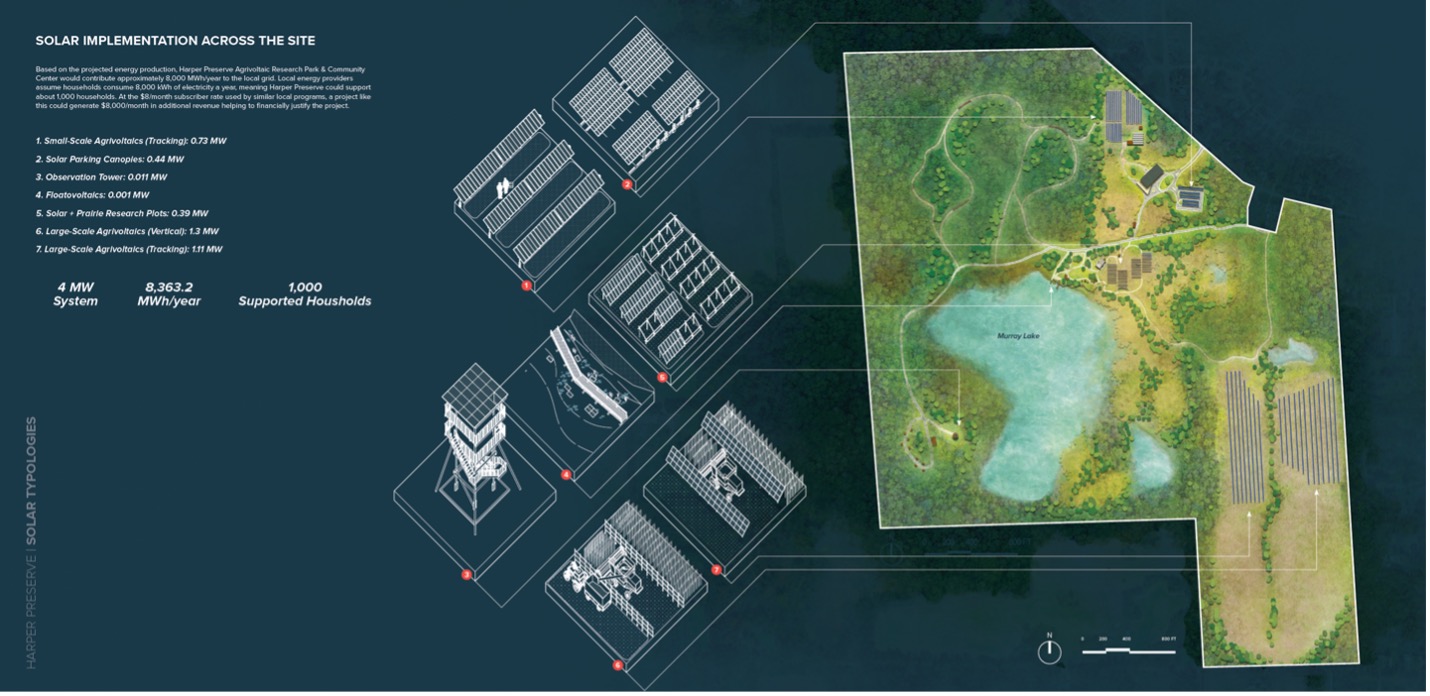
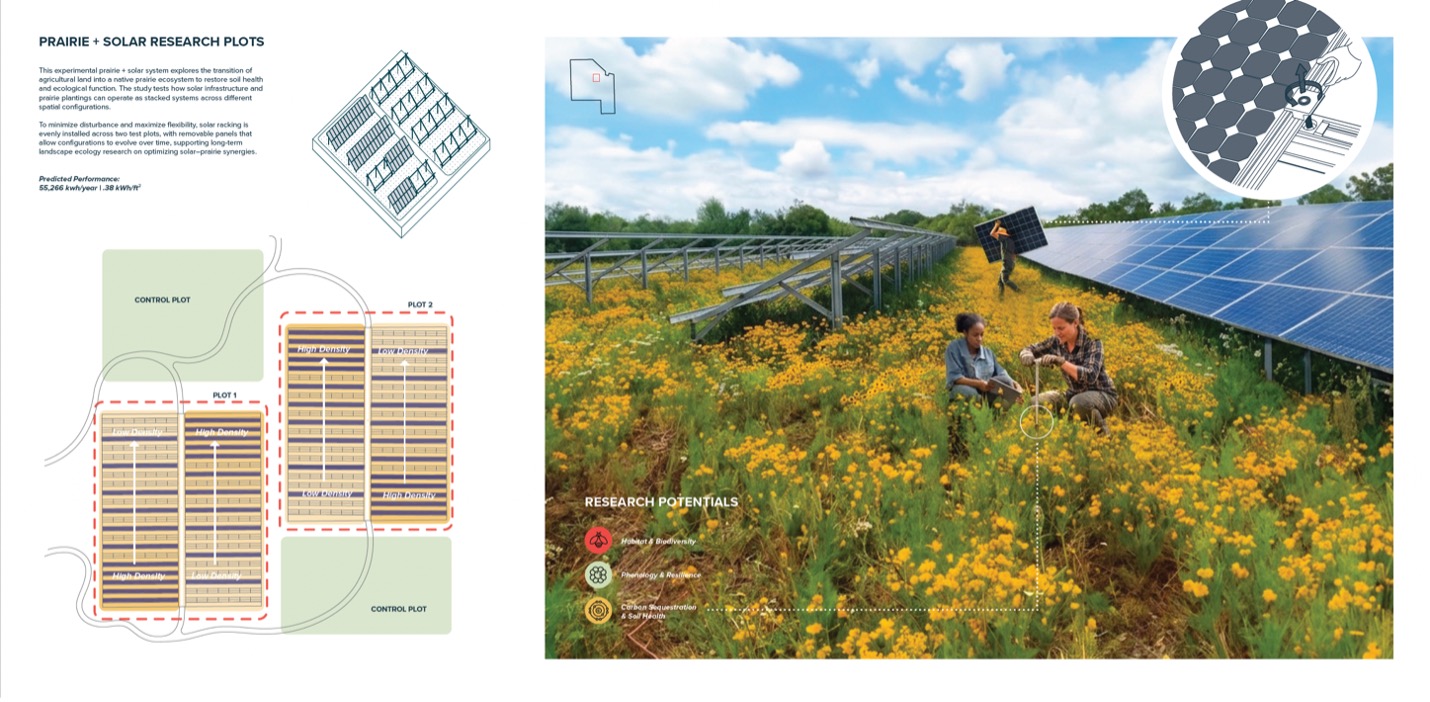
Exploring multifunctional solar landscapes at Harper Preserve. The conceptual design integrates diverse solar technologies, including agrivoltaics and prairie research plots (top), and explores how solar infrastructure could support prairie restoration, biodiversity and ecological research (bottom).
Learning from rural communities and the energy transition
The studio challenged students to consider the social, ecological and economic implications of renewable energy development, including how large-scale solar projects can affect rural communities.
“This course changed the way I think about renewable energy,” said Perazzo. “As environmental scientists and sustainability advocates, it can be easy for us to see any solar energy project as an inherently positive step in the transition away from fossil fuels, and to view opposition to solar development as a barrier to that transition.”
Through the project, students examined concerns about agricultural land competition, rural landscape character, habitat fragmentation and whether communities hosting renewable energy infrastructure share in its benefits.
“The challenge is not just how we build more renewable energy, but how we build it thoughtfully,” Perazzo added.
For Vaccaro, the project demonstrated how landscape architecture can help address challenges that extend beyond conventional design.
“Having our interdisciplinary work, which focused on community, renewable energy production and ecology, acknowledged at this level feels like a reflection of the many fields and industries landscape architecture can touch, and the exciting roles landscape architects can play within them.”
The value of interdisciplinary collaboration
For Ko, the project reflects the value of bringing students from different disciplines together to tackle complex environmental challenges.
“What excites me most about teaching at SEAS is bringing students from different disciplines into the same studio,” Ko said. “Landscape Architecture students bring spatial thinking and design, while students in planning, policy, ecology and other environmental fields bring different ways of understanding the same problem. Some of my most rewarding student projects have grown from this kind of interdisciplinary collaboration.”
Building on this approach, Ko will offer two complementary courses in Winter 2027: EAS 689: Landscape Planning and Analysis (Winter A, 2 credits) and EAS 690: Landscape Planning and Design (Winter B, 2 credits). Students from across SEAS and other disciplines, including those without prior design experience, are encouraged to enroll and explore how interdisciplinary planning and design can address pressing environmental and land-use challenges.