


 back to all news
Detroit-UM Living Learning Lab Supports Three Community-University Partnerships
Image

Caption
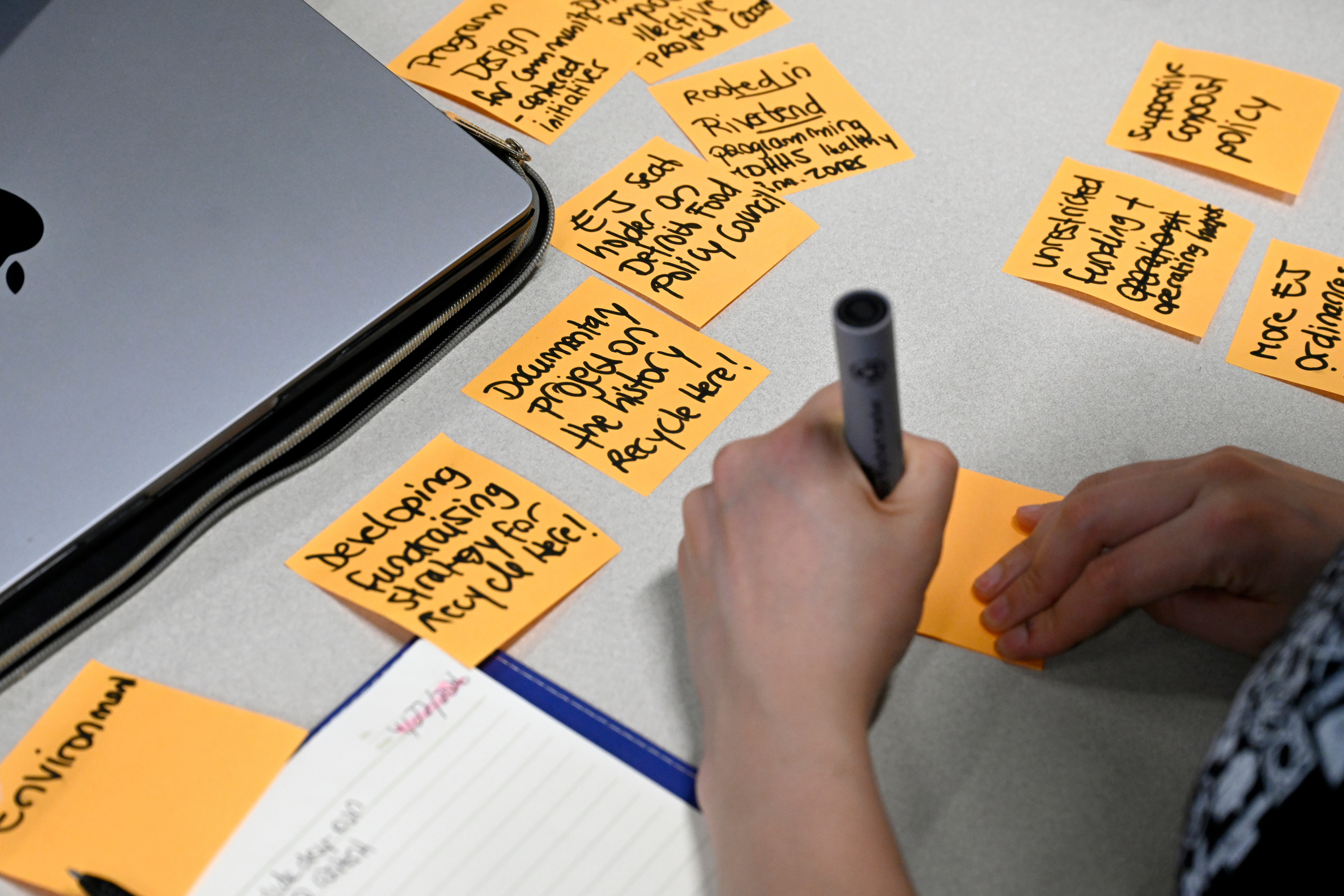
Living Learning Lab participant adds notes to the breakout session visioning board: "What would it look like to model, scale, and test climate-resilient housing in Detroit?" Photo credit: Jose Juarez, University of Michigan Photography
The University of Michigan School for Environment and Sustainability (SEAS) Detroit Sustainability Clinic and Taubman College Climate Futures have awarded $6,000 across three partnerships through the Detroit-UM Living Learning Lab Flex Grant, supporting collaboration between University of Michigan faculty and Detroit-based organizations working to advance community resilience.
The Clinic and Climate Futures launched the Detroit-UM Living Learning Lab, with support from the U-M Center for Democracy & Civic Empowerment, in April with an Earth Day visioning workshop. The workshop, held at the U-M Detroit Center, brought together community leaders, researchers and sustainability practitioners to help shape the initiative and explore opportunities for stronger, more sustained collaboration between Detroit organizations and the university.
Following the workshop, participants were invited to apply for seed funding to advance collaborative projects. The grants provide flexible support for projects at different stages of development, from exploring new ideas and strengthening project plans to moving existing work toward implementation. A central goal of the funding is to support partnership development and preliminary work needed to pursue additional funding.
“These small grants are an early example of how the Detroit-UM Living Learning Lab is putting the ideas and partnerships developed during our initial convening into practice,” said Tony Reames, Director of the SEAS Detroit Sustainability Clinic. “By providing participants with resources to advance collaborative projects, we’re extending the concepts and conversations from our Earth Day workshop to support the vision of authentic, sustained community-university collaboration,” continued Reames
Detroit-UM Living Learning Lab Flex Grant Recipients
Grandmont Rosedale Development Corporation, d-mix lab, and Taubman College
Michael Randall of The Grandmont Rosedale Development Corporation (GRDC) and Taubman College Professor Sheng-Hung Lee with the University of Michigan d-mix lab will partner to develop community-centered strategies for healthier, more equitable, and resilient neighborhoods in Northwest Detroit. Grounded in the notion of Design for Longevity (D4L), the project will engage community members across generations to identify neighborhood health priorities and develop design concepts, visual materials, and tools to support future planning and engagement. Using the D4L Toolkit as a participatory design method, the team will also document community insights and recommendations, laying the groundwork for future implementation, externally funded research and continued collaboration between GRDC and U-M.
Southwest Detroit Environmental Vision and U-M Dearborn
Denysse Camarena of Southwest Detroit Environmental Vision (SDEV) and U-M Dearborn Professor Paul Draus will partner with local youth to explore the environmental and community benefits of green infrastructure at Jurassic Park, a youth-led green space in Southwest Detroit, as well as the Fort Street Bridge Park, a small public green space located in the industrial Rouge River corridor. The project will examine how tree plantings and rain gardens could improve stormwater management while exploring their broader community benefits within each space. Youth will participate in applied research, stewardship and environmental education activities while helping develop maintenance strategies to make the spaces more sustainable while increasing community benefit.
Sacred Spaces, School for Environment & Sustainability, and Taubman College
jøn kent of Sacred Spaces, Dolores Perales-Lara of Cadillac Urban Gardens, School for Environment and Sustainability Professor Heidi Hauserman, and Taubman College Professor Lesli Hoey will partner to develop a coordinated, multi-year capstone pipeline focused on food sovereignty and environmental justice in Detroit. The collaboration will begin with a SEAS master’s student exit project, running from Fall 2026 through Fall 2027, to develop a justice-oriented GIS Food Sovereignty Atlas combining Detroit’s socioeconomic and political realities with urban food-production capacity modeling and environmental assessments, followed by a Taubman Master of Urban and Regional Planning capstone in Winter 2028 that will use the SEAS data to explore zoning and permitting reforms and design scenarios supporting Detroit’s urban food system. The funding will support one part-time intern, coordinated by Sacred Spaces and Cadillac Urban Gardens, to work with FoodLOOP partners to finalize the project scope, confirm faculty leads, formalize data-sharing and site-access agreements, coordinate the two schools’ work as components of a shared strategic plan, and prepare materials such as memoranda of understanding, site lists, and survey and interview protocols.
About the Detroit-UM Living Learning Lab
The Detroit-UM Living Learning Lab is a collaborative initiative of the SEAS Detroit Sustainability Clinic and Taubman College Climate Futures. With support from the U-M Center for Democracy & Civic Empowerment, the Lab supports strengthening collaboration between Detroit community organizations and U-M partners to develop place-based approaches to urban sustainability and climate resilience.