


 back to all news
Improved refrigeration could save nearly half of the 1.3 billion tons of food wasted each year globally
Image

Caption
Concept photo of a long row of boxes filled with fruits and vegetables in the background, depicting a modern supermarket interior. Image credit: Nicole Smith, made with Stable Cascade
Contact: [email protected]
ANN ARBOR—About a third of the food produced globally each year goes to waste, while approximately 800 million people suffer from hunger, according to the U.N.'s Food and Agriculture Organization.
A new University of Michigan study concludes that nearly half of the food waste, about 620 million metric tons, could be eliminated by fully refrigerated food supply chains worldwide.
At the same time, fully refrigerated supply chains, or "cold chains," could cut food waste-related emissions of climate-warming greenhouse gases by 41% globally, according to the study published online May 28 in the peer-reviewed journal Environmental Research Letters.
Sub-Saharan Africa and South and Southeast Asia have the greatest potential for reductions in both food losses and related emissions through increased cold-chain implementation, according to the study.
South and Southeast Asia could see a 45% reduction in food losses and a 54% decrease in associated emissions under an optimized refrigeration scenario. Sub-Saharan Africa has tremendous opportunities for both food loss (47%) and emissions (66%) reductions under optimized refrigeration conditions, the study shows.
And in many situations, developing more localized, less industrialized "farm-to-table" food supply chains may yield food savings comparable to optimized cold chains, according to the study.
"I was surprised to find the scale of our opportunity for reducing food loss and waste globally," said study lead author Aaron Friedman-Heiman, a master's student at U-M's School for Environment and Sustainability and Ross School of Business. "Approximately half of the roughly 1.3 billion tons of food that goes to waste annually can be solved through food supply-chain optimization."
The other author is Shelie Miller, a professor at U-M's School for Environment and Sustainability and at the College of Engineering.
Food losses produce an estimated 8% of human-caused greenhouse gas emissions. The new U-M study focuses on food losses in the post-harvest to retail stages of the food supply chain and does not address on-farm or at-home losses.
The study accounts for the greenhouse gases emitted during food production. It does not include emissions tied to refrigeration or other supply-chain operations and does not include emissions from food waste in landfills.
The study, funded in part by Carrier Global Corp., found that:
- The greatest opportunity to improve food losses in less industrialized economies is the supply chain between the farm and the consumer. But in North America, Europe and other more industrialized regions, most food loss happens at the household level, so cold chain improvements would not have a major impact on total food losses.
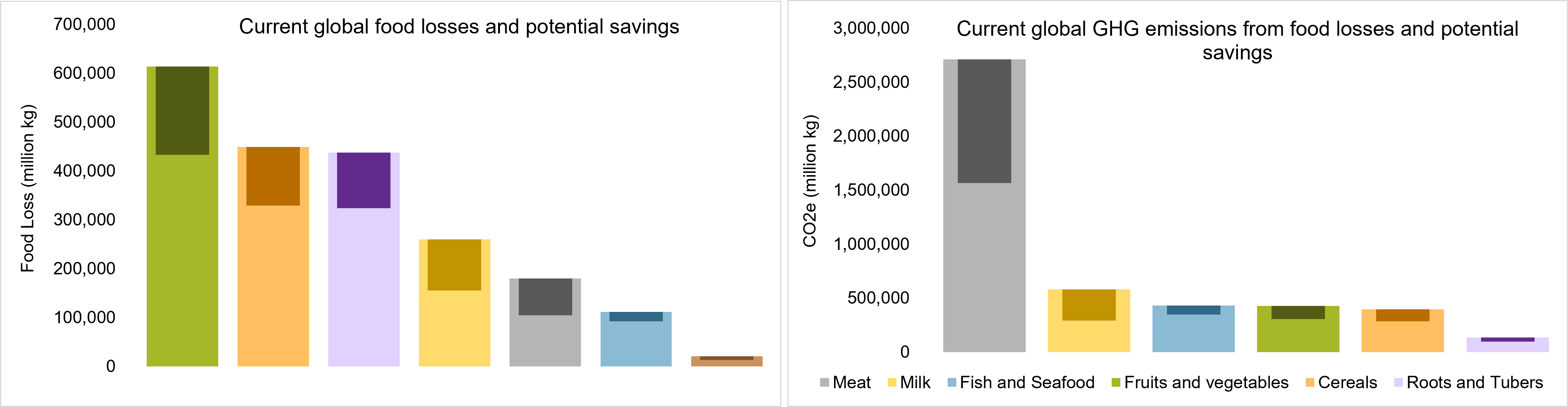
- Reinforcing previous research, the U-M study highlights the importance of meat-related food losses. While the amount of fruit and vegetable losses is much higher, by weight, throughout the world, the climate-related emissions associated with meat losses are consistently greater than those associated with any other food type—due mainly to the high greenhouse gas intensity of meat production.
- Unlike previous studies of this topic, the U-M researchers compared the benefits of globalized, technologically advanced food-supply chains with those of localized "farm-to-table" food systems. "Hyper-localized food systems resulted in lower food losses than optimized global, refrigerated supply chains," Friedman-Heiman said. "The results help quantify the value of maintaining and supporting local food chains."
For the study, the researchers built a food-loss estimation tool to assess how improved access to the cold chain could impact food loss and its associated greenhouse gas emissions for seven food types in seven regions. They used data from the U.N. Food and Agriculture Organization and other sources.
By modeling food losses at each stage of the supply chain, the study highlights where the cold chain can be optimized to reduce food losses and emissions. The researchers analyzed the effects of moving from the current state of inconsistent and variable-quality cold chains throughout the world to an optimized system, defined as one with high-quality refrigeration across all stages.
The study estimates that poor cold-chain infrastructure could be responsible for up to 620 million metric tons of global food loss annually, resulting in emissions of 1.8 billion tons of carbon dioxide equivalents, the equivalent of 28% of U.S. annual greenhouse gas emissions.
The researchers say their adaptable, easy-to-use tool will be of use to anyone involved in the food supply chain, including farmers, grocery retailers, government officials and nongovernmental organizations.
"Although cold chain infrastructure is rapidly increasing worldwide, an optimized cold chain will likely develop at different rates and in different ways across the globe," Miller said. "This analysis demonstrates that while increased refrigeration should lead to improvements in both food loss and greenhouse gas emissions associated with food loss, there are important tradeoffs associated with cold chain improvements by food type and region."
She said Investment decisions will need to be prioritized to maximize the desired outcomes and impacts. For example, if an NGO's top priority is ending hunger, then cold-chain upgrades that provide the greatest overall food-loss reductions may best meet that objective.
But organizations that prioritize climate action may choose to focus on reducing meat losses specifically, rather than total food losses.
The study found that meat accounts for more than 50% of food loss-related greenhouse gas emissions, despite accounting for less than 10% of global food losses by weight. Optimized refrigeration of meat could result in the elimination of more than 43% of emissions associated with meat loss, according to the study.
The researchers emphasize that the actual amount of greenhouse gas emissions savings will depend on the efficiency of cold-chain technologies and the carbon intensity of local electrical grids, since climate emissions associated with refrigeration can be significant.
The U-M study was supported by the U.S. National Science Foundation and by Carrier Global Corp., a global leader in intelligent climate and energy solutions.
Study: The impact of refrigeration on food losses and associated greenhouse gas emissions throughout the supply chain (DOI: 10.1088/1748-9326/ad4c7b)
This article originally appeared on the Michigan News website.