


 back to all news
Intergenerational perspectives on environmental justice and resilience focus of MLK Day talk
Image

Caption
From left: Nayomi Cawthorne, Donna Givens Davidson, Madeline Miller and Karina Yang
Three generations of environmental justice leaders gathered January 22 to speak at a fireside chat about how intergenerational collaboration can strengthen the environmental movement. The event was hosted by the University of Michigan School for Environment and Sustainability’s (SEAS) Office of Community Impact and Engagement in honor of Martin Luther King Jr. Day. The panel was moderated by SEAS student Nayomi Cawthorne (MS/MPH ’27), and featured Donna Givens Davidson (BA ’87), president and CEO of Eastside Community Network, Madeline Miller (PhD ’25), founder and CEO of NexTiles, and Karina Yang (BS ’26), a U-M student in the Program in the Environment and Biology, Health and Society.
The group discussed some of their own challenges and joys from their environmental justice work and highlighted how solving the climate crisis requires intergenerational work.
The Value of Working Across Generations
For Givens Davidson, who has over 40 years of leadership experience in areas of youth and family development, community economic development, community partnerships and community education, the divide in the awareness of environmental issues is clear. Her generation, she says, was dismissed as “tree huggers” pursuing “very weird, fringe kinds of things.” In contrast, she says today’s generation grasps the urgency of climate change.
Miller, a recent SEAS graduate, added that “younger generations get it. Younger generations are afraid of what it’s going to be like in 20 and 30 years. They have a stake in this that we don’t—there’s more centrality to this.” Miller emphasized that working across generations goes beyond inviting younger generations to the table and includes genuinely sharing knowledge and power. “I think it’s not just important to have intergenerational conversations, but to know how to share power, because you can hire young people and then kill them and silence them, or you can learn from them,” she said.
Miller, who founded a textile recycling company in Detroit, emphasized that the energy exhibited by youth should be balanced with taking into account elder perspectives. “We’re in an era where we are being told that the climate crisis is not real and it’s not happening, and we are vulnerable because the people who have the most power are not doing anything,” she said. “There’s an opportunity for us to use a lot of anger at this point as fuel. But that urgency and innovation and excitement, it needs balance, and it requires a wisdom that only our elders have.”
Yang emphasized understanding the importance of honoring the foundations of the environmental movement. “Our older generations have this invaluable wisdom about the different challenges, strategies and progress that has really shaped our current environmental justice movement,” she said. “As part of a generation of emerging environmental leaders, I think that it’s really important to be part of intergenerational collaboration so that we can really honor the work that has come before us and also push the movement forward.”
Navigating Climate Anxiety and Finding Joy
Cawthorne asked the panel about how different generations work to manage the weight of climate anxiety and fatalism that often appears in climate work. Miller shared her experiences of seeing the anger of high school students on tours of her textile warehouse when hearing that 92 million tons of textile waste goes to landfills each year. “I think that anger has to be channeled. Otherwise, our younger generation experiences burnout, and they’re less inclined to get involved and to vote and to do things that in the past felt impactful but no longer do, because they don’t see those changes,” she said. “Where we have the resources to extend opportunities for involvement, I think that is our duty.”
Yang spoke about the anxiety that younger generations feel towards the future. “Our generation is really experiencing a lot of climate anxiety about whether there will be an opportunity to move forward and make change,” she said. “I think that my role right now as a student is to learn with purpose and hone my skills with the intent to make meaningful change."
Givens Davidson described how important it is to focus on the controllables, or identifying what you can influence. “If I focused on national news, I would be paralyzed. And so I hyper-focus on the things that I can change, the things I really care about and the people who are around me,” she said.
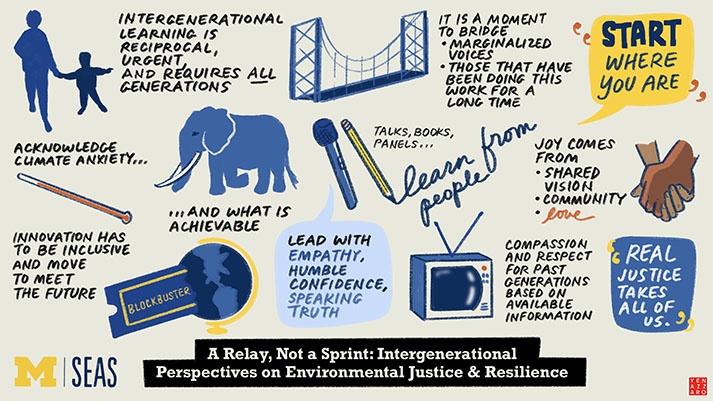
“A Relay, Not a Sprint.” The graphic emphasizes intergenerational learning, empathy, joy and shared responsibility in advancing environmental justice and resilience."
Moving Forward Intergenerationally
The panelists ended by reflecting on what they wished other generations knew and how to move forward intergenerationally. Givens Davidson asked that younger generations have compassion for older generations, noting her generation had less access to information as compared to the connected world today. She also gave a call to embrace younger leaders. “You need to open your arms and let them guide you because they can make you better. Young people are not a threat. They are a resource if we let them be.”
Miller wanted older generations to know their work is valued. “I wish our elders knew how cool we think they are and how proud we are and how impressive their contributions were,” she noted.
Both stressed the importance of adaptation and innovation. “If the world changes and you don’t, then you’re no longer effective. We have to innovate,” Givens Davidson said, while Miller noted that innovation must center the people it serves. “I’m learning to create products, solutions and new things with people and not just about them, because when you exclude them, it just may not work.”
As Cawthorne closed the event, she reminded attendees of King’s words: “The arc of the moral universe is long, but it bends towards justice.”