


 back to all news
Michigan Sen. Sue Shink: Shaping environmental policy at the local and state levels
Image
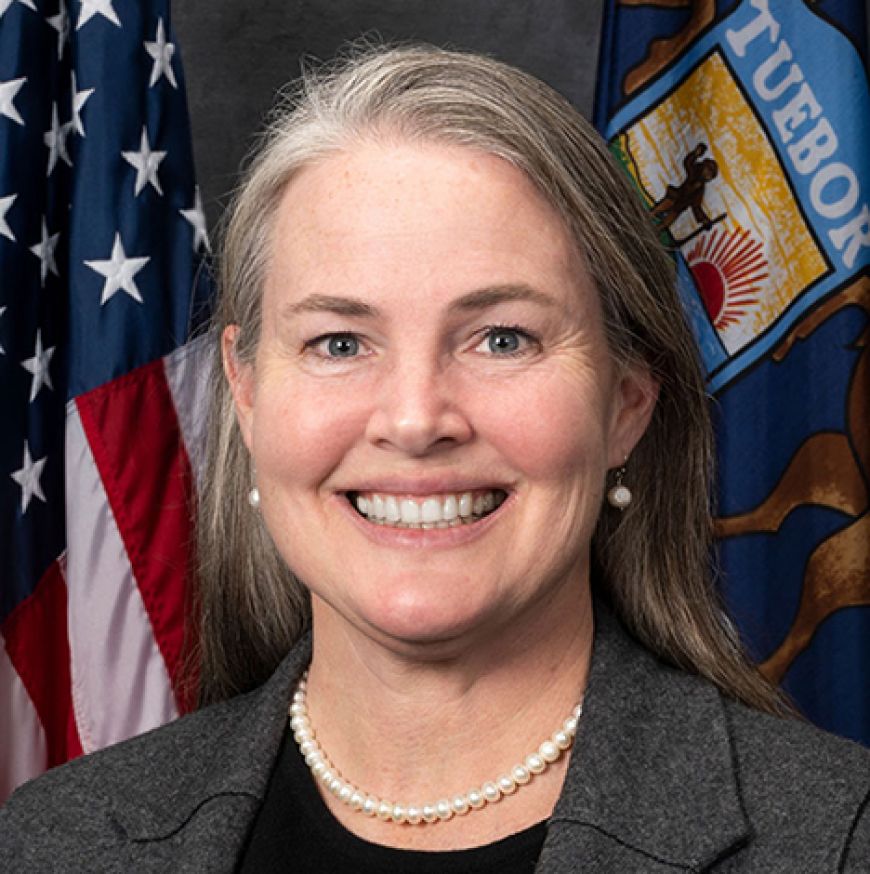
How does an upbringing as a public servant in a politically divided district influence climate action in today’s Michigan? How does one navigate the complex intersections of current statewide climate and economic needs, to best benefit everyone from rural to urban communities? State Senator Sue Shink (BA ’89, MS/JD ’95), the representative of Michigan’s 14th Senate District and former Washtenaw County Commissioner, is a veteran public servant with seasoned expertise fighting for environmental and economic policies that elevate the health and resiliency of constituents.
In her recent talk at the University of Michigan School for Environment and Sustainability (SEAS), Shink delivered a powerful message explaining how her past academic and professional experiences are informing her current efforts to advance climate action and natural land preservation in the state. Shink, who earned a BA, MS, and JD at the University of Michigan, addressed an audience of students, faculty, and community members on March 4.
Shink, who currently operates a family farm while serving her first term as state senator, began her talk reflecting on her experiences as a Wolverine. She earned her BA in political science in 1989, then pursued a dual MS/JD at Michigan Law School and SEAS, where she completed a master’s thesis on sustainability in a suburban community. She credits this, along with her fond memories of time spent outdoors in the beautiful Michigan woods, with her early interest in sustainability.
After completing her degrees at U-M, Shink began her first foray into the local political scene as a member of the League of Women Voters. She became involved with many early climate action efforts there, including working on water rights, nonpartisan climate action, and campaigning against pollution in the Great Lakes and Lake Saint Clair.
Shink became involved with partisan politics after serving as a Northfield Township Trustee. During this time, she began to focus her energy on farmland and natural area preservation. Shink would go on to serve as a founding member and chair of the Agricultural Land Preservation Advisory Committee (ALPAC) and has been instrumental in preserving over 20,000 acres of Michigan farmland and natural areas.
Shink now serves as the state senator for Michigan’s 14th district, after a time as Chair of Washtenaw County’s Board of Commissioners and as a member of the Washtenaw County Food Council. Her commitment to environmental legislation is reflected in an ambitious climate package recently signed into law by Governor Gretchen Whitmer, which boasts $15 billion in economic benefits. Another bill, titled “Michigan the Beautiful,” would preserve 30% of Michigan’s farmland and natural areas.
Shink went on to talk extensively about her work supporting the clean energy bill, and the lessons she has learned while advocating for climate policy in a politically divided district. Acknowledging the difficulties in passing such legislation while balancing the needs of a diverse constituency, she recounted her strategies for garnering support, including rallying former allies and accepting necessary compromises.
The Senator also touched upon current conflicts, such as the opposition to solar siting in rural townships from local communities. Despite these challenges, Shink emphasized the importance of maintaining the initial goals of legislation and the role of a public servant. She frequently called back to her impression, as a SEAS student, of the school’s culture of “expecting to do good in the world,” contrasting it to the less public service-oriented culture she found at the Law School.
When fielding audience questions, Shink identified climate change as the most pressing issue for her district, with erratic weather patterns impacting farming and severe flooding causing substantial damage. She pointed out the risks posed by contaminated sites like Gelman, the conversion of farmland into subdivisions, and failing septic systems.
For those considering public office, Shink's advice was unequivocal: "Be a good person!" She encouraged taking chances, becoming familiar with local party politics, and maintaining transparency about one's past.
In connecting with rural communities, Shink advocated for straightforward communication and focusing on shared values and goals, especially regarding environmental stewardship. She advised against letting policy discussions become mired by people who are unwilling to discuss solutions that work.
When discussing the complexity of her role at the state level compared to local governance, Shink acknowledged the broader impact attainable at the state level, despite sometimes missing the direct community involvement of local work. She ran for the Senate out of concern for democracy in Michigan and has helped to enact broader changes across the state.
Concluding the event, Shink's final insights centered on how to influence peers and uplift those supporting laudable causes. Noting the importance of emotional control and objectivity, she emphasized effectively using personal connections with peers and community members as a tool for advocacy and encouraged elevating those who align with one's own values, especially in the face of environmental challenges.