


 back to all news
SEAS celebrates 35th anniversary of the Center for Sustainable Systems
Image

Caption
The Honorable Dalai Lama (left) with CSS Co-Director Greg Keoleian and former CSS Co-Director Jonathan Bulkley. The Dalai Lama was the featured speaker at the Wege Lecture in 2008, which was the largest event in CSS' history. His talk focused on bringing people together for the planet.
What started as a three-year initiative became a permanent research hub to advance solutions to sustainability issues
The Center for Sustainable Systems (CSS) at the University of Michigan School for Environment and Sustainability (SEAS) is celebrating 35 years of researching, developing and applying solutions to global sustainability challenges. CSS has evolved into a world leader in developing and applying systems analysis tools and operationalizing sustainable development for business, industry, government and communities.
History of CSS
Greg Keoleian, CSS co-director and SEAS professor, launched the project with former SEAS and Civil and Environmental Engineering Professor Jonathan Bulkley as the National Pollution Prevention Center for Higher Education (NPPC) in 1991 with a competitive grant from the U.S. Environmental Protection Agency. The center started with a mission to develop and disseminate educational resources about pollution prevention, but its early success with systems analysis projects demonstrated that there was an opportunity to expand its sustainability research and collaborations.
In 1997, the NPCC coined the term “sustainable systems” to denote this integration of systems analysis methods into the study of sustainability, and officially changed its name to the Center for Sustainable Systems in 1999. “Some people thought we were crazy at the time,” said Keoleian, reflecting on CSS’ novel approach to analyzing sustainability through a systems analysis lens. “Thirty-five years later we have many accomplishments to celebrate thanks to the amazing talents of the core faculty, staff and students and their many successful collaborations with business and industry, government, NGOs and communities.”
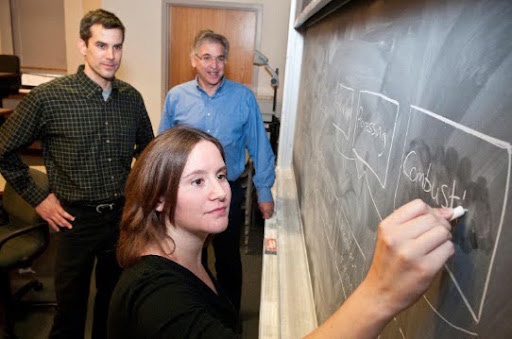
Former CSS student researcher Kevin Bolon (PhD ’11), CSS Co-Director Greg Keoleian and former CSS student researcher Shoshannah Lenski (MS ’11).
CSS became a permanent institution at U-M in 2004, leading to the launch of the Sustainable Systems specialization at SEAS in 2006 and an Engineering Sustainable Systems dual-degree program with Michigan Engineering in 2007.
The center has grown from two faculty in 1991 to nine core faculty, two research scientists, five research specialists, and over 40 postdocs and student researchers in 2026.
“In addition to conducting impactful and relevant research, CSS is dedicated to mentoring and training students for their future careers,” said Shelie Miller, CSS co-director and a SEAS professor. “We’ve been fortunate to work with so many excellent students over the years who have done great work while they are here and continue to make an impact in the world after they graduate.”
CSS Research and Accomplishments
The work that CSS has undertaken in the realm of systems-level analysis has led to major breakthroughs and essential frameworks to guide business, governments and scholarly practices.
“We focus on all systems, from mobility to energy, from the built environment to food systems, as well as other systems for meeting human needs,” explained Keoleian. “And we consider the full life cycle of these systems where needs are met with production and consumption activities that have environmental, social and economic impacts. We engage with stakeholders to guide the development of the technology, design, enterprise, policy, markets and behavior drivers of transformational change.”
Examples of CSS’ impact over 35 years include:
- The pioneering of life cycle assessment tools for vehicles, residences and photovoltaics.
- Green principles for sustainable energy pathways, including grid storage.
- Life cycle optimization for product replacement policy.
- Bridging energy system and climate models to better account for climate change in energy planning and operations.
- The mapping of carbon hoofprint of U.S. cities, climate change denialism and spatial planning of green infrastructure
- Creating energy justice models of residential energy use and efficiency disparities.
- Analyzing green hydrogen pathways for decarbonizing transportation.
CSS has also collaborated on projects with companies, governments, nonprofit foundations and NGOs. Examples of those projects include:
- Developing a greenhouse gas inventory for the City of Detroit.
- Partnering with the State of Michigan to develop strategies for reducing greenhouse gas emissions, establish a Michigan Maritime Strategy, and assess the effectiveness of the Michigan Bottle Bill policy.
- Estimating an environmental footprint and developing a sustainability plan for Meijer.
- Producing the first sustainability report for the U-M campus using modeled glide paths to carbon neutrality.
- Developing and publishing a cross-campus carbon accounting model for the President’s Commission on Carbon Neutrality.
These collaborations have garnered CSS attention from major media platforms. Research on flying cars, the dietary effects on GHG emissions, the energy impact of electric vehicles and the carbon footprint of residential homes have all made national headlines.
The work has also won researchers from CSS numerous awards, such as:
- Shelie Miller, who received the 2020 Graedel Senior Best Paper Prize for "Life cycle assessment of emerging technologies.”
- Michael Craig, who received the Institute of Industrial & Systems Engineers (IISE) Energy Systems Division’s Outstanding Young Investigator Award and an NSF CAREER Award, both in 2022.
- Josh Newell, who was named the 2025 Highly Cited Researcher by Clarivate/Web of Science.
- Greg Keoleian, who was awarded the International Society for Industrial Ecology Society Prize at the ISIE Conference in Singapore in 2025.
CSS Factsheets
Beyond its research, partnerships and achievements, CSS has made sustainability knowledge accessible to a broad public audience. In 2001, CSS launched three factsheets, which were the start of a collection that now contains 34 factsheets on topics ranging from energy and mobility to food and water. CSS updates the factsheets annually, and they regularly receive over 500,000 views.
Wege Lecture
CSS has also hosted the prestigious Wege Lecture since 2001, a landmark speaker series that has brought world leaders in climate and sustainability studies to the U-M campus. The event has hosted notable speakers, including:
- Al Gore, 45th Vice President of the United States
- Christina Figueres, Architect of the Paris Climate Agreement
- Naomi Klein, author, activist and co-director of the Center for Climate Justice
- Jennifer M. Granholm, 16th United States Secretary of Energy
Looking Ahead
As CSS celebrates its 35th anniversary, Keoleian is already looking ahead to what’s next for the center. “The outlook for the CSS team and its graduates is bright; there is a critical need for systems-based solutions to transportation, energy, water, built environment, information technology, consumer goods and food system problems,” he said. “It is a privilege to be a part of this high-impact organization which continues to accelerate solutions and advance sustainability.”