


 back to all faculty
Inés Ibáñez

Professor; Associate Dean for Academic Affairs
Ecosystem Science and Management
Conservation + Restoration

Office
Dana 2546
Lab website
About
Our research program quantifies forest ecosystem functioning — the physiological and biological processes including photosynthesis, biomass production, decomposition, and carbon cycling that determine forest productivity, carbon storage, and resilience — to build tractable, multi-process models that support forest management and climate change adaptation.
Publications
Probst, C. et al. 2026. Resource declines shape phenological and morphological responses to climate change. PNAS 123 (26) e2607714123 doi.org/10.1073/pnas.2607714123
Jenkins, L. et al. 2026. Fecundity and terrain-climate interactions that shape tree niche differences across North America and Europe. Journal of Ecology 114: e70369 doi.org/10.1111/1365-2745.70369
Requena-Mullor J.M. and Ibáñez I. 2026. Linking problems with solutions: Biomass waste is where most needed to mitigate energy demand during tropical nights. Journal of Photogrammetry and Remote Sensing 238: 497-507 https://doi.org/10.1016/j.isprsjprs.2026.05.030
Clark, J.S. et al. 2026. Despite rapid warming, seed production is not leading poleward migration in North American and European forests. New Phytologist 251: 164-178 doi: 10.1111/nph.71223
Pradhan, N., I. Ibáñez, A. Chhatre, A. Duddu, H. W. Fischer, P. Newton, J. A. Oldekop, S. J. Wilson, and A. Agrawal. 2026. Synergies between poverty reduction and biodiversity conservation. Nature Sustainability. https://doi.org/10.1038/s41893-026-01830-x
Pradhan, N., I. Ibáñez, A. Chhatre, A. Duddu, H. W. Fischer, P. Newton, J. A. Oldekop, S. J. Wilson, and A. Agrawal. 2026. Advancing Biodiversity Through Poverty Solutions. Nature Sustainability. https://doi.org/10.1038/s41893-026-01816-9
McCarthy-Neumann, S, Wood, KEA, Ibáñez I, Kobe, R.K. 2026. Mycorrhizal identity of neighboring trees shapes seedling survival and plant-soil feedbacks through trait and light interactions. Functional Ecology: 00, 1–17. https://doi.org/10.1111/1365-2435.70290
Clark, J.S. et al. 2026. Continental contrasts in climate extremes that control tree fecundity. Global Change Biology 32, no. 2: e70738. https://doi.org/10.1111/gcb.70738.
Vought OK, Kivlin SN, Shulman HB, Sorensen PO, Inouye DW, Ibáñez I, Falb P, Rand K, Classen AT. 2025. Earlier snowmelt increases the strength of the carbon sink in montane meadows unequally across the growing season. Journal of Ecology https://doi.org/10.1111/1365-2745.70195
Umaña MN, Thiessen S, Fuentes-Rohwer T, Desai H, Ibáñez I. 2025. How do drought and elevated temperatures influence CO2 fertilization effects on tree seedling performance? A global meta-analysis. Journal of Ecology 113(10): 2875-2888. https://doi.org/10.1111/1365-2745.70133
Schaffer-Morrison S, Vi AN, McNutt N, Ibáñez I, Umaña MN. 2025. The combined effects of low light and low water on seedling growth vary in their severity based upon tree species and seedling traits. CJFR 55: 1-21. https://doi.org/10.1139/cjfr-2025-0031
Zheng, L. et al. 2025. Neighborhood diversity increases tree growth in experimental forests more in wetter climates but not in wetter years. Nature Ecology & Evolution. https://doi.org/10.1038/s41559-025-02805-5
Blumenthal, D., Diez, J., Pearse, I., Sofaer, H., Sorte, C., Barnett, D., Beaury, E., Bradley, B., Dukes, J., Early, R., Ibáñez, I., Laughlin, D., Petri, L., Vila, M., Corbin, J. 2025. Why are non-native plants successful? Consistently fast economic traits and novel origin jointly explain abundance across U.S. ecoregions. New Phytologist DOI: 10.1111/nph.70307
Ibáñez I, McPherson MR, Upchurch RA, Zak DR. 2025. Mycorrhizal Fungi Influence on Mature Tree Growth: Stronger in High-Nitrogen Soils for an EMF-Associated Tree and in Low-Nitrogen Soils for Two AMF-Associated Trees. Plant-Environment Interactions 6(3): e70055.
Bradley BA, et al. 2025. A Quantitative Classification of the Geography of Non-Native Flora in the United States. Global Ecology and Biogeography 34(4): e70041. DOI: https://doi.org/10.1111/geb.70041
Buonaiuto, D., et al. 2025. Using plant invasions to compare occurrence- and abundance-based calculations of biotic homogenization: are results complementary or contradictory? Global Ecology and Biogeography DOI: https://doi.org/10.1111/geb.70022
Petri, L. and Ibáñez I. 2025. Successful recovery of native plants post-invasive removal in forest understories is driven by native community features. Ecological Applications In press. DOI: http://dx.doi.org/10.1002/eap.70012
Research
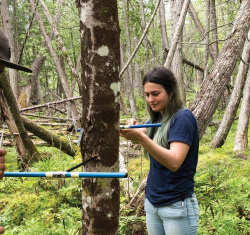
Our research spans four interconnected areas. A core of our field work addresses forest resilience to climate change by identifying the constraints that limit tree species recruitment (the establishment and survival of new trees), locating the source regions from which tree populations could migrate as climate conditions shift, and assessing the vulnerability of existing forests to water loss and productivity decline. We also examine forests' vulnerability to biological invasions by quantifying how local and regional factors combine to determine how much invasions reduce native species richness. We study how mycorrhizal fungi shape tree nitrogen access and, in turn, tree growth responses to elevated atmospheric CO2. In our most recent work, we are addressing cold-season controls on annual forest carbon budgets in temperate and boreal forests, examining how winter and shoulder-season processes — snowpack dynamics, soil freeze-thaw cycles, and year-round respiration belowground and in tree stems — shape both overwinter carbon loss and subsequent growing-season productivity. Together, these lines of research generate quantitative, species-level estimates of forest performance and resilience to environmental change that advance forest ecology while directly informing forest managers, policymakers, and other decision makers.
Education
PhD., Duke University (ecology)
M.S., Utah State University (range sciences)
B.S., Universidad Complutense de Madrid (botany)
In the News



In the Media