


 back to all faculty
Michaela Theresia Zint

Arthur F. Thurnau Professor
School for Environment and Sustainability
School of Education
College of Literature, Science & the Arts
Environmental science education | Climate communication |
Sustainability transformation
School of Education
College of Literature, Science & the Arts
Environmental science education | Climate communication |
Sustainability transformation
Behavior, Education, and Communication
Cross-cutting

Office
3516 Dana
Websites
About
Michaela T. Zint is an Arthur F. Thurnau Professor whose work focuses on how science education, communication, and institutional change can accelerate society’s response to environmental challenges such as climate change. Her research integrates natural and social sciences to understand how people learn about complex environmental systems and how education—from K-12 through higher education—can translate scientific knowledge into informed public engagement and action.
Her work spans environmental science education, climate communication, environmental decision-making, and sustainability transformation across K–12, higher education, and adult and workforce education. She collaborates with agencies, schools, universities, NGOs, and international partners to design, enact, and evaluate programs that help learners and institutions apply scientific knowledge to real-world environmental challenges.
Professor Zint served as Associate Dean for Academic Affairs in the School for Environment and Sustainability at the University of Michigan (2019–2025). She currently serves on the governing board (Unirat) of the University of Natural Resources and Life Sciences (BOKU) in Vienna, Austria.
Publications
-
Brundiers, K., Barth, M., Cebrian, G., Cohen, M., Diaz, L., Doucette-Remington, S., Dripps, W., Habron, G., Harre, N., Jarchow, M., Losch, K., Michel, J., Mochizuki, Y., Rieckmann, M., Parnell, R., Walker, P., & Zint, M. (2021). Key competencies in sustainability in higher education: Toward an agreed-upon reference framework. Sustainability Science, 16(1), 13–29. https://doi.org/10.1007/s11625-020-00838-2
-
Carman, J. P., Zint, M., Burkett, E., & Ibanez, I. (2021). The role of interest in climate change instruction. Science Education, 105(2), 309–352. https://doi.org/10.1002/sce.21610
-
Duvall, J., & Zint, M. (2007). A review of research on the effectiveness of environmental education in promoting intergenerational learning. Journal of Environmental Education, 38(4), 14–24. https://doi.org/10.3200/JOEE.38.4.14-24
-
Brook, A., Zint, M., & DeYoung, R. (2003). Private landowners' responses to an endangered species act listing: Implications for conservation. Conservation Biology, 17(6), 1638–1649. https://doi.org/10.1046/j.1523-1739.2003.01765.x
-
Zint, M. (2002). Comparing three attitude-behavior theories for predicting science teachers’ intentions. Journal of Research in Science Teaching, 39(9), 819–844. https://doi.org/10.1002/tea.10047
Read more publications here.
Research
Professor Zint’s research focuses on the intersection of science learning, environmental decision-making, and societal responses to environmental change.
Key areas include:
- Climate change education and communication
- Environmental decision-making and behavior change
- Science learning and public engagement with environmental risk
- Sustainability competencies in higher education
- Institutional transformation for sustainability and climate action
- Climate emotions and pathways from climate concern to climate action
Grants:
-
Advancing Climate Education (ACE 1.0 & 2.0). 2023-present. University of Michigan, Office of the Provost, $68,075 (Principal Investigator).
-
Building students' environmental knowledge and engagement with local government through civic science. 2021-present. Institute of Education Sciences: National Center for Education Research: Civics Education and Social Studies, $391,127 (Collaborator/Subcontractor).
-
Innovative Pedagogies for Cultivating Leadership Amidst the Climate Change Crisis. 2020-2023. University of Michigan, School for Environment & Sustainability, $55,000 (Lead PI).
-
Michigan Sustainability Cases: Transforming case-based teaching and environmental training. 2016-2021. University of Michigan, Third Century Initiative, $1.6 million (Co-Principal Investigator).
-
Planting Roots, Branching Out: A proposal to continue exploring the benefits of an education program design to foster middle school students’ understanding of Michigan’s trees and forests – and – the impacts of climate change on these resources. 2014-2016. US Forest Service McIntire-Stennis Research Program, $55,000 (Principal Investigator).
Accolades
National and International Impact
Professor Zint has led or contributed to initiatives translating research into educational practice and policy. Her work includes:
- Development and evaluation of environmental education initiatives supported by U.S. federal agencies, including the U.S. Environmental Protection Agency and the National Oceanic and Atmospheric Administration.
- Research and program development on climate change education in higher education institutions
- Advising universities and sustainability initiatives on how education can accelerate climate action, institutional transformation, and sustainability transitions.
Signature Initiatives
Advancing Climate Education (ACE) (Launched 2022)
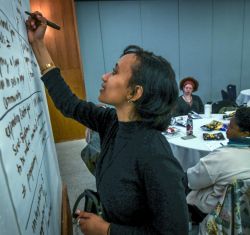
Founder of the Advancing Climate Education initiative at the University of Michigan, bringing together hundreds of students, faculty, and administrators across the university to develop strategies for addressing climate change through education and institutional action.
Act on Climate MOOC (Launched 2017)
Co-developer, with students as partners, of Act on Climate: Steps to Individual, Community, and Political Action, a massive open online course available on Coursera, that has supported thousands of learners in translating climate science knowledge into action.
MEERA: Environmental Education Evaluation Resource Assistant (Launched 2008)
Developer of MEERA, a web-based evaluation resource used by environmental educators worldwide to design and assess environmental education programs. The platform has served over 700,000 users from across the world.
Invited Presentations
- Turning Climate Anxiety into Action (2026)— University of Natural Resources and Life Sciences (BOKU), Vienna, Austria
- Reprogramming Computer Science Education for a Sustainable Future (2026) — University of Technology (TU), Vienna, Austria
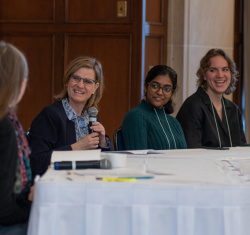
- Climate Emotions & Action (2024) — University of Michigan Provost Seminar, Ann Arbor, USA
Education
PhD, Michigan State University (Department of Fisheries and Wildlife, Human Dimensions)
MBA, Michigan State University (marketing)
BA, Michigan State University (Hotel, Restaurant and Institutional Management)
In the News



In the Media