The average surface temperatures of common urban materials in Ann Arbor, Michigan, when the sun is at its highest point in the sky. Image credit: Keenan Gibbons
Greener by Design: How SEAS Landscape Architects are Making Cities More Sustainable
Landscape architects have long played a key role in promoting sustainable, beautiful and functional spaces. In cities, in particular, their work is vital to mitigating environmental challenges like the urban heat island effect, stormwater management and ecological restoration. As cities strive to become climate resilient, landscape architecture faculty and students at SEAS are laser-focused on finding sustainable solutions that benefit the public.
Cooling Urban Heat Islands
People don’t realize it, but on average, cities are 14 to 20 degrees hotter than rural areas. This is due in large part to the urban heat island effect caused by building materials, asphalt, dark surfaces and perhaps most notably, a lack of trees. Keenan Gibbons, a lecturer at the University of Michigan School for Environment and Sustainability (SEAS) and a landscape architect with SmithGroup, is using infrared drones to find hot spots in cities and cool them down, which is crucial for public health, energy conservation and sustainability.
This nationwide work, which began in 2018, started in Ann Arbor on Huron Street, where Gibbons was hired to redesign the landscape, including the planting of 130 shade trees.
Keenan Gibbons
“It was a pretty big transformation from that barren sidewalk,” says Gibbons. “We established a baseline temperature and have measured it in the years since, and by year five, we measured a reduction in surface temperatures by about 12 degrees.”
Gibbons, whose work is mostly based in Detroit, where he’s currently working on the Corktown Greenway, a community-centered project that will span multiple streets and integrate green spaces and bike lanes, says that reducing surface temperatures is essential as we learn to live on a warming planet.
“While some of my work is mitigating the issues working with what’s already there, adding green spaces, water, shade and brightly colored materials, the ultimate goal is to help inform better design decisions in the future,” says Gibbons.
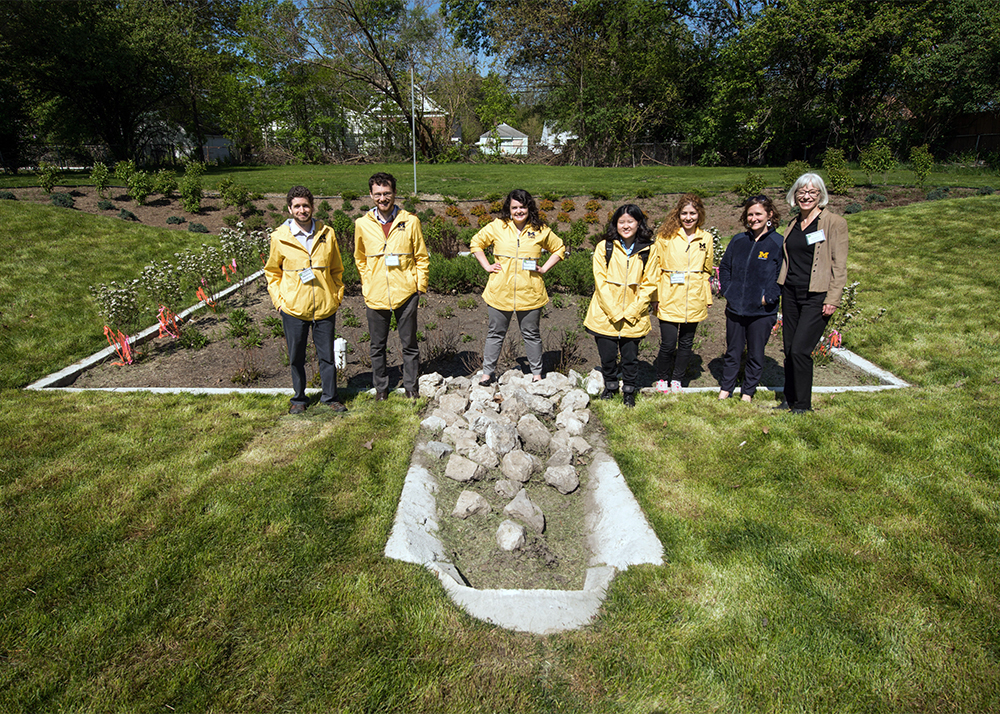
From left to right, members of the Neighborhood, Environment and Water research collaborations for Green Infrastructure project (NEW-GI): Noah Webster, SEAS associate research scientist, Nathaniel Lichten (MS '15), Rachel Leonard (MLA '16), Lanfei Liu (MLA '17), Sanaz Chamanara (MLA '17, PhD '22), Natalie Sampson, professor, U-M-Dearborn and Joan Nassauer, SEAS professor. The team is pictured at the Evergreen pilot site to celebrate the opening of all four Detroit pilot sites with community members, elected officials and agency staff. Photo by Dave Brenner
Green Stormwater Solutions
Following her groundbreaking work in Minnesota in the mid-1990s, which included design and implementation of rainwater gardens, now commonly seen in cities throughout the U.S., SEAS Professor Joan Nassauer says that her interest in green stormwater infrastructure, a method of managing stormwater runoff using systems that mimic natural processes to absorb, filter and store water, is part of the reason she came to U-M.
“It was obvious to me that there were enormous opportunities for green stormwater infrastructure in Detroit. Even when I started working with community partners there in 1999, there were 10,000 vacant properties in the city, and it was clear they could be selectively employed as part of neighborhood green stormwater infrastructure,” says Nassauer.
With a focus on urban design that incorporates the stormwater management potentials of vacant property, Nassauer has built partnerships in Detroit that have allowed her and her students to contribute to a shift from skepticism about green infrastructure to understanding its importance for limiting downstream pollution and climate-induced localized flooding, with profound impacts on people and ecosystems.
Nassauer says that the landscape characteristics of different cities, with varying local community aesthetics, are essential to the successful implementation of green infrastructure.
“Detroit is a relatively flat landscape with clayey soils and many vacant lots and existing green spaces, so green infrastructure should be designed differently than in Seattle or Los Angeles,” says Nassauer. “For every city, local community aesthetics matter. People are more likely to want it in their own neighborhood if it looks attractive to their eye rather than neglected.”
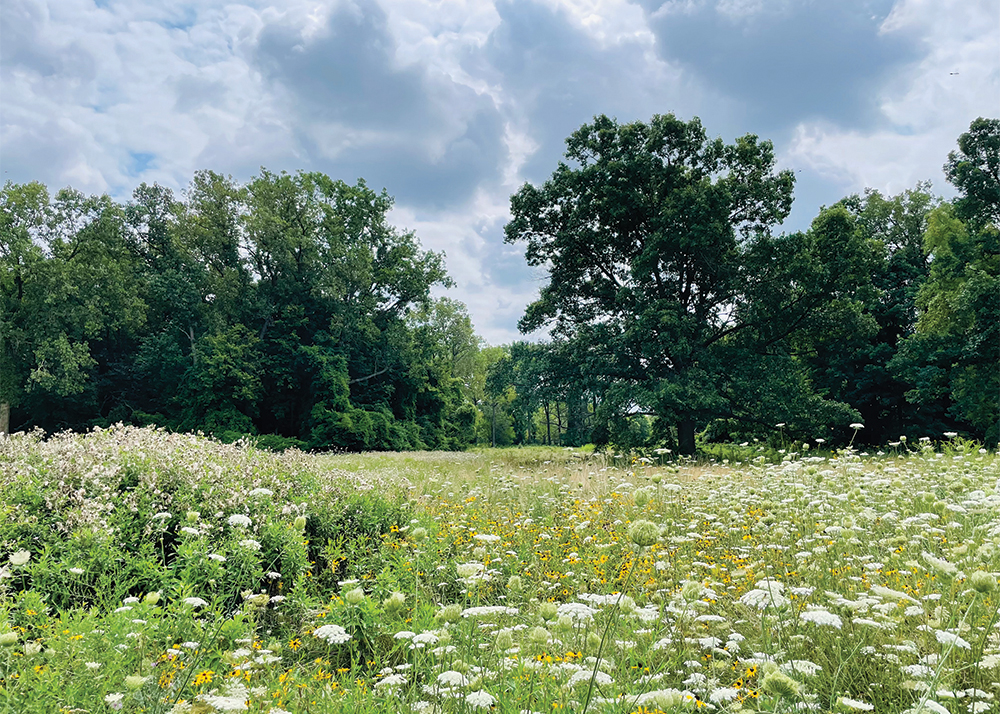
The inner loop of Detroit's Eliza Howell Park in summer, where previous restoration efforts and a period of reduced maintenance due to the COVID pandemic allowed native species to reemerge. The SEAS capstone team built upon this natural regeneration and recommended planting and management strategies that would further enhance the park's biodiversity and beauty. Photo by Emily Brent (MLA/MS '25).
Mapping for Ecological Restoration
Making decisions about land use, ecological restoration and climate resilience in cities means having clear and up-to-date information. This can be harder than it seems, which is why Lisa DuRussel (BS ’02, MLA ’06), SEAS associate professor of practice and engagement, and her students recently worked on affordable and accessible ways to gather the visual and spatial context needed to ensure the successful restoration and future planning for Eliza Howell Park in Detroit, a capstone project supported by the Detroit Sustainability Clinic.
Lisa DuRussel (BS ’02, MLA ’06)
“Last spring, we collaborated with Sidewalk Detroit, a nonprofit that engages with residents to improve public spaces, and the City of Detroit, to connect our ecological and design expertise with geographic information systems mapping to offer a low-cost way to map out lots and properties at the park rather than hiring a costly surveyor,” says DuRussel.
Using a drone, the project team was able to evaluate landscape-scale ecological conditions that are often difficult to assess quickly and affordably, such as canopy cover, drainage analysis, vegetation health and erosion, and provide high-resolution data to inform restoration, design and planning.
The project resulted in ecological management recommendations for the 250-acre mostly undeveloped park, and a strategy for climate-resilient and biodiverse landscapes that can be replicated across all of Detroit’s parks.
“The impact of this work can reach multiple communities throughout Detroit as the city strives for holistic management, ecological resilience and accessibility of its parks for years to come,” says DuRussel
SEAS Assistant Professor Parth Vaishnav and SEAS PhD student Mallika Kothari are studying how residents in Ann Arbor’s Bryant neighborhood cope with power outages of greater than 12 hours. Their work is a small slice of a much larger project to make Bryant the nation’s first carbon-neutral neighborhood.
In two separate but related studies, SEAS research led by Benjamin Goldstein and Joshua Newell underscore how meat connects rural areas where it’s produced to urban areas responsible for most of its consumption. In doing so, the team also revealed how the environmental impacts of meat vary widely across the country.
People across the U.S. who live in hurricane-, wildfire- or drought-prone areas may be considering relocating to other places that are perceived as being safer from the effects of climate change. Derek Van Berkel is helping communities plan for climate migration now, so they can be more adaptable and sustainable in the future.