


Our Mission and Vision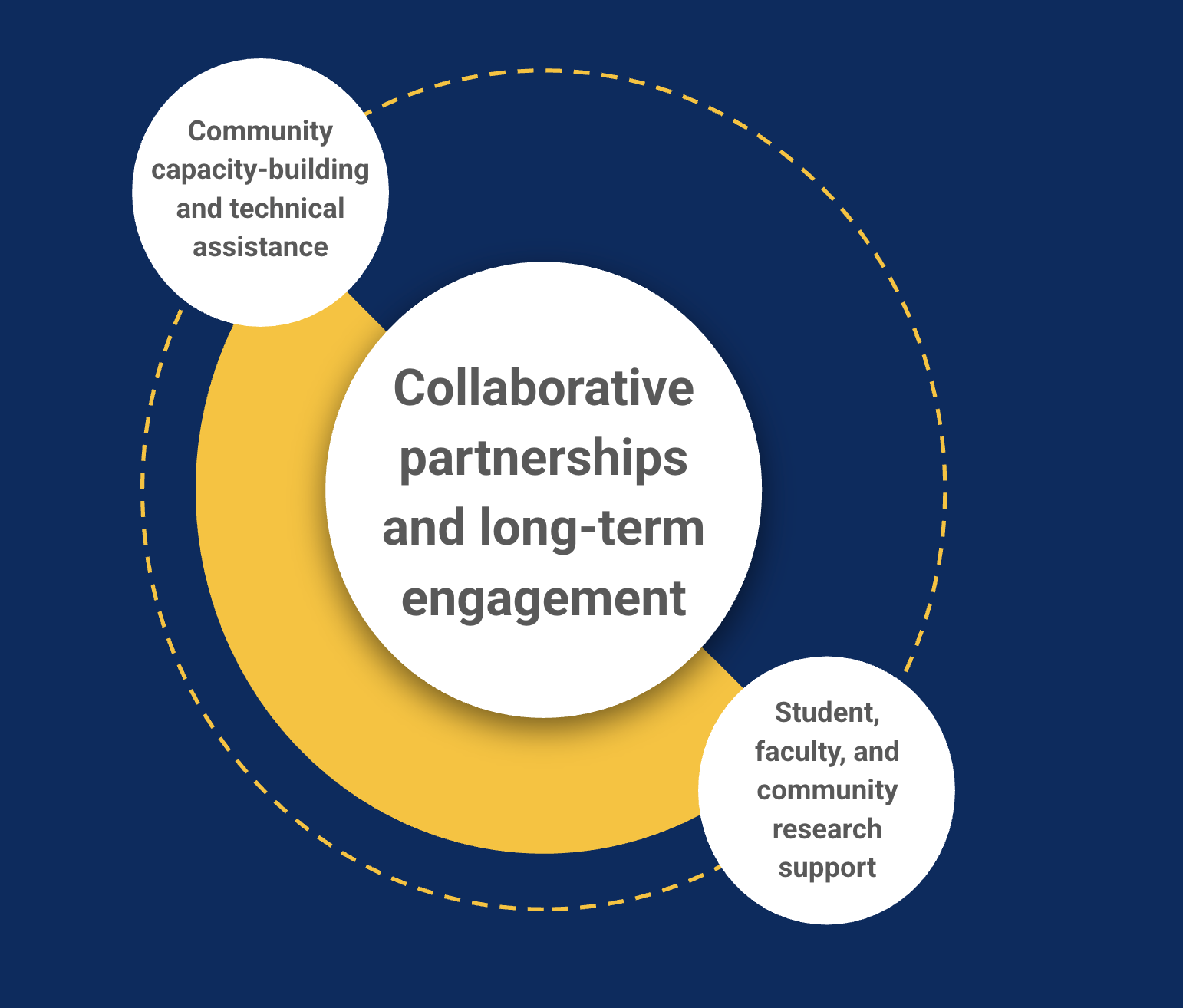
Our vision is to advance climate resilience, equity, and environmental justice for historically underserved communities in and around Detroit.
We achieve this by providing resources and multi-year engagement opportunities that foster long-term relationships and connect university partners with Detroit-area leaders, activists, and visionaries.
Our Goals
The Clinic supports community-driven sustainability efforts by working towards the following goals:
- Providing technical assistance, capacity-building, and resources for local governments, community-based organizations, and nonprofits.
- Strengthening and building partnerships between the university and Metro Detroit communities to improve public services and support long-term collaboration.
- Supporting affordable delivery of services through partnerships and research to improve quality of life.
Our Focus Areas
Environmental, Energy, and Water Justice
We support projects that advance equity, affordability, accessibility, and public participation in decision-making across Detroit communities.
Housing and Neighborhoods
Our work supports efforts to revitalize neighborhoods, address housing quality and affordability, and improve the overall livability of Detroit’s residential communities.
Green Infrastructure and Watershed Management
We help design and implement nature-based solutions to reduce stormwater runoff, improve water quality, and address urban flooding.
Sustainability and Climate Action
We collaborate on initiatives that reduce greenhouse gas emissions, build climate resilience, and ensure sustainability efforts balance social, economic, and environmental needs.
Circular Economy
We support projects that reduce waste and repurpose materials into new products, helping Detroit transition to more local, regenerative, and resource-efficient systems.
Our Impact
Our History

With generous support from the Kresge Foundation, the SEAS Detroit Sustainability Clinic was established in 2021 to create partnerships that connect Detroit-based organizations and local governments to university resources to advance community-identified sustainability goals. Kerry C. Duggan was appointed as the director, with Dr. Bill Currie serving as the principal investigator (PI). In 2024, Dr. Tony G. Reames assumed both roles as director and PI, reimagining the Clinic’s foundation and vision.
Timeline of Key Milestones
-
2021 – The Clinic initiated its first Clinic Capstone Project in partnership with Jefferson East, Inc., expanding the Clinic’s scope into long-term partnerships.
-
2022 – The Clinic received an Engage Detroit Workshop Grant to host a one-day event, "Building a Sustainable Future for Detroit," focused on water infrastructure, climate resilience, flooding, river restoration, and water access. In partnership with Jefferson East, Inc. and the Detroit Riverfront Conservancy, workshop participants co-developed a consensus statement and actionable strategies to address water infrastructure, river restoration, and equity issues that SEAS faculty and community organizations can pursue collaboratively.
-
2023 – The Lester Family Blight to Beauty Fund was established, funding Detroit Blight to Beauty Capstone Projects aligned with the City of Detroit’s “Blight to Beauty” campaign, which focuses on safety, beautification, and neighborhood revitalization.
That same year, the Clinic launched its first Community Resilience Project, supporting shorter-term, community-led initiatives through student collaboration and faculty support.
-
2024 – The Clinic hosted its first Day in Detroit at the Charles H. Wright African American History Museum and its first SEAS project Showcase. Day in Detroit engaged students at the heart of Detroit, while the SEAS Project Showcase highlighted the Clinic's impactful work.
-
2025 – The Clinic rolled out a suite of new services and programs deepening the Clinic’s focus on urban sustainability, leadership development, and rapid-response support:
- Urban Sustainability & Justice Faculty and Community Fellows Program, connecting scholars and community leaders for a knowledge exchange on innovative urban sustainability solutions.
- Sustainability Assistance Project Pilot, delivering rapid-response technical assistance to community partners.
- Urban Sustainability & Justice Summer Fellows Program, supporting recent graduates working for the Clinic.
- MobilizeGreen Virtual Summer Internship, partnering with the nonprofit, MobilizeGreen, to offer SEAS students hands-on experience working on sustainability projects in Detroit.
The Clinic also opened its first dedicated office in 2025 in the historic Julian C. Madison Building, thereby increasing its visibility and accessibility to Detroit-area community partners.
- 2026 – The Kresge Foundation renews its support with a $900,000 commitment.